
Hybrid Boards: Face-Cam Host Plus AI B-Roll Without Visual Whiplash
Plan face-cam vs AI beats on one board: transition, crop, and color-match rules—and when pure host or pure AI is cleaner.
Hybrid Boards: Face-Cam Host Plus AI B-Roll Without Visual Whiplash
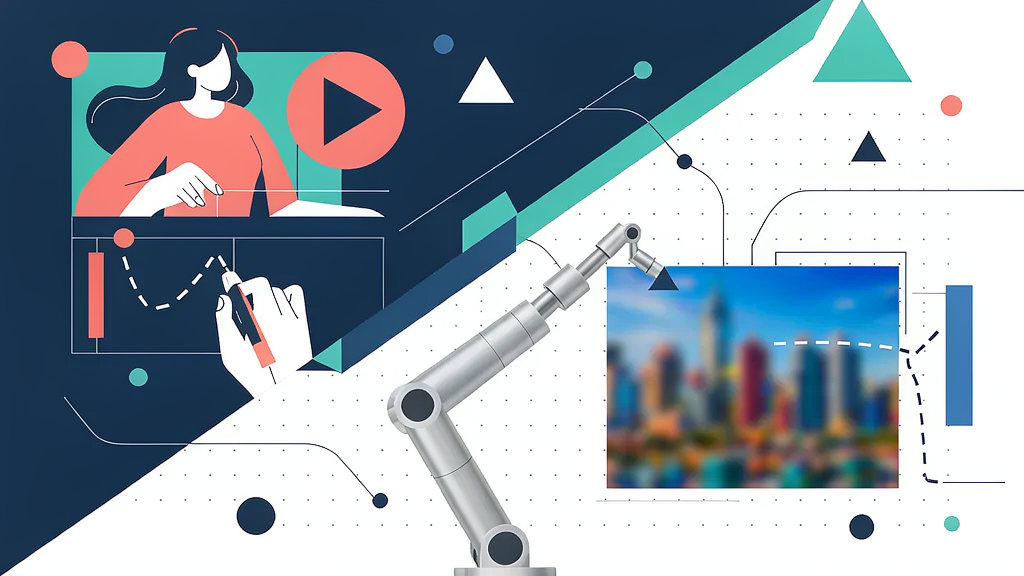
Plan boards that mix real host footage with AI-generated support visuals. Trust comes from the face; clarity often comes from stylized B-roll—whiplash comes from ignoring the cut.
Founders and coaches want face trust plus teachable metaphors. Choosing UGC-style vs studio host is a different decision (UGC-style host vs studio host). This article assumes you already picked a real host and need beat-level rules for when that face appears versus AI support.
Beat-type → face vs AI rule
| Beat type | Default | Prefer face-cam | Prefer AI B-roll |
|---|---|---|---|
| Hook / promise | Face or hybrid | Credibility, personal IP | Bold metaphor hook |
| Definition card | AI still + caption | Host reading dense terms (rare) | Always for term cards |
| Method (UI) | Demo UI / AI UI crop | Host pointing at monitor | Clean UI without host occlusion |
| Method (concept) | AI metaphor | Host analogy to camera | Abstract systems |
| Proof | Face or real UI | Testimonial energy, promises | Diagrammed proof |
| Transition | Short AI or hard cut | Host turn / gesture wipe | Match-cut metaphors |
| Disclaimer | Face or still card | Regulated “said on camera” | High-contrast still |
| Soft CTA | Face | Personal ask | Series plate |
Write the rule on every frame: F (face), A (AI), H (hybrid picture-in-picture). Marking beats before generation prevents accidental face regenerations.
Transition, crop, and color-match notes
Transitions
- Prefer hard cuts on intent changes; dissolves often scream “stock”
- If bridging face → AI, use a gesture, glance, or caption wipe—not a random zoom
- Keep AI motion language quieter than host performance so the eye knows who leads
Crop
- Lock host framing (MCU vs CU) across the series (one host face across lines)
- AI plates should leave safe zones for captions identical to host plates
- Avoid PiP that covers the teach text; place PiP opposite captions
Color match
- Grade host footage toward the AI palette triad—or generate AI to match host light
- Forbid AI backgrounds that jump from daylight office to neon void mid-sentence
- Carry one key light direction across both sources when possible
- Reject AI skins that invent a second wardrobe palette
Pair visual type choices with B-roll vs demo UI per beat so you are not generating metaphors where a UI crop teaches faster.
When pure AI host or pure talking-head is cleaner
Pure talking-head when:
- The lesson is a personal story or opinionated framework
- Regulated claims need a human mouth
- AI metaphors keep distracting from the rule
- You lack time to color-match two pipelines
Pure AI (or AI host) when:
- You need multilingual faces or privacy
- The teach is diagram-heavy
- Host filming capacity is the bottleneck
- Brand already runs a locked AI character bible
Hybrid is a third mode—not the brave default. If half your beats fail color QA, simplify.
Board markup that prevents whiplash
On each beat record:
- Source tag — F / A / H
- Light note — “host key left / AI match left”
- Palette reference still
- Caption safe rectangle
- Transition in/out
- Audio — host VO vs VO bed vs mute-first captions only
Annotate so non-editors can review (storyboard annotation). Stakeholders should approve source tags, not argue after the edit.
Common failure modes
- Host in warm tungsten cut to cold cyan AI every three seconds
- AI face morphs that almost match the real host (uncanny cousin)
- Decorative AI particle fields behind dense captions
- Host explaining UI while AI shows a different product skin
- Regenerating host likeness with image models “for consistency” instead of using real footage
Post-render, include “source continuity” on the QA list (post-render QA).
Audio continuity across hybrid cuts
Visual match is half the battle; audio whiplash is the rest.
- Prefer one VO bed (host or studio) across AI plates
- Keep room tone consistent under face-cam; do not hard-cut to sterile AI silence without a caption hold
- Mute-first captions must teach even if VO drops on AI beats
- Avoid AI lip-sync faces attempting to match the real host—use real mouth for speech
If you need multilingual delivery, lock face-cam for language A and consider caption/VO tracks for language B rather than regenerating a pseudo-host (one board, two languages).
Wardrobe and prop continuity
- Host wardrobe palette listed on the board
- AI metaphors avoid introducing clashing accent colors
- Physical props on desk should not teleport between cuts unless intentional
- Glasses reflections and mic presence stay consistent on face beats
Photograph a reference still of the host setup and attach it beside AI style swatches in the board pack.
Decision tree: hybrid vs simplify
- Does face trust matter for this claim? If no → pure AI/diagrams may win
- Does any beat require real facial nuance? If yes → keep face for those beats only
- Can you staff color-match QA? If no → pure talking-head until you can
- Are AI plates actually teaching? If no → cut them
Hybrid is a craft choice with an ops cost. Budget the QA.
Soft production tip
Mark face-cam vs AI beats on the board before any generation. Storyboard-first workflows (including Scro) make the F/A/H column part of approval so render queues never invent a second host.
Checklist
- Every beat tagged F/A/H
- Palette and light match notes filled
- PiP does not cover captions
- Pure modes considered and rejected with a reason—or chosen
- No almost-host AI faces
- Transitions justified
- Style lock shared across both sources
Hybrid boards earn trust when the face leads emotionally and AI leads explanation—without fighting each other for the eye.