
Pores and Skin, Not Airbrush
Visible pores and a slight unevenness read as skin. Airbrush reads as a filter, even when the light is right.
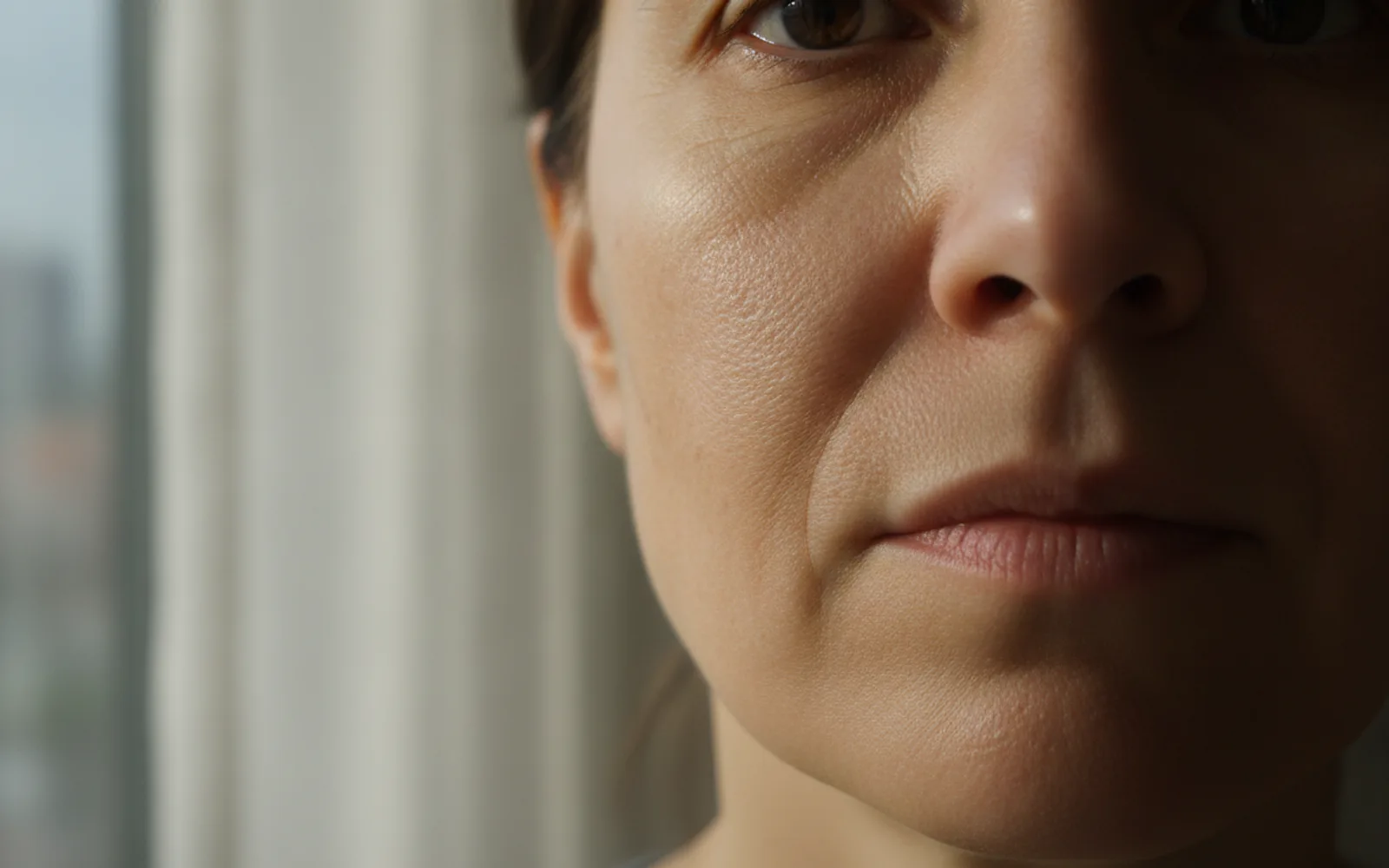
Pores make skin look photographed. An even, poreless cheek looks filtered, and a filtered face looks generated the moment it sits next to a real room. Ask for visible skin texture and a little uneven tone. Do not ask for flawless, porcelain, or beauty lighting. Those words are the airbrush. A realistic face is still an AI face: looking human is not a way to skip a label where a platform asks for one.
Ban the beauty words
Drop flawless, porcelain, glass skin, and retouched. Add "pores visible, slight unevenness, no beauty filter." You are describing a camera, not a cosmetics ad.
Texture follows the light
Pores show on the bright cheek and soften in the shadow. If the entire face is uniformly grainy, you added noise, not skin. If no cheek has texture, you added a filter.
Do not invent damage
Texture is not a request for wounds or a medical condition. A natural variation in tone is enough. Do not promise a skincare result you cannot show with a real product.
A worked example
Window light, pores on the lit cheek, a faint natural variation, no smoothing. The still is approved. A porcelain pass is deleted.
Check the still
- The lit cheek has pores.
- Texture is not uniform noise.
- Beauty words are out of the prompt.
Where Scro fits
Lock this skin with the face in Scro. Wardrobe and Life photos should not beautify the head into someone else. Approve the still before the talk. Export 9:16.
Keep the skin you would approve. Finished samples are on the examples page.
Related: Reference Photos for One Face.