
5 Book Summary Explainer Formats for YouTube
Turn nonfiction books into viral faceless YouTube and Reels explainers with 5 visual summary formats—illustrated with Seedream examples.

Book summary channels are one of the fastest-growing segments on YouTube and Instagram because millions of people buy nonfiction books they never finish reading. However, summarizing a whole book chapter-by-chapter in a short video puts viewers to sleep. High-retention book channels extract a single counter-intuitive framework from the book and draw it as a visual diagram. Here are five proven book-summary explainer formats you can build with Scro.
1. The 1% Daily Compounding Curve (Habit & Growth Books)

When summarizing habit, skill-building, or investing books, open with the visual gap between a flat trajectory and an exponential curve. Seeing the flat early stage explains why most people quit right before the curve bends upward.
2. Common Myth vs. Book Truth Split Board

Hook viewers in the first three seconds by contrasting what everyone assumes ('Work longer hours') with the author's actual finding ('Protect two deep-focus blocks'). The visual split makes the takeaway memorable on mute.
3. The Four-Part Habit Loop (Cue → Craving → Response → Reward)

Psychology and behavioral books revolve around feedback loops. Drawing a four-node clockwise circle on one wooden board lets viewers see how changing a single node (the environmental cue) rewires the entire loop.
4. The Three-Layer Pyramid Framework

Books on leadership, nutrition, Maslow-style needs, or financial security map naturally onto a three-tier pyramid: foundation at the bottom, leverage in the middle, and peak mastery at the top.
5. Historical Case Study Story Arc (Character + Turning Point)
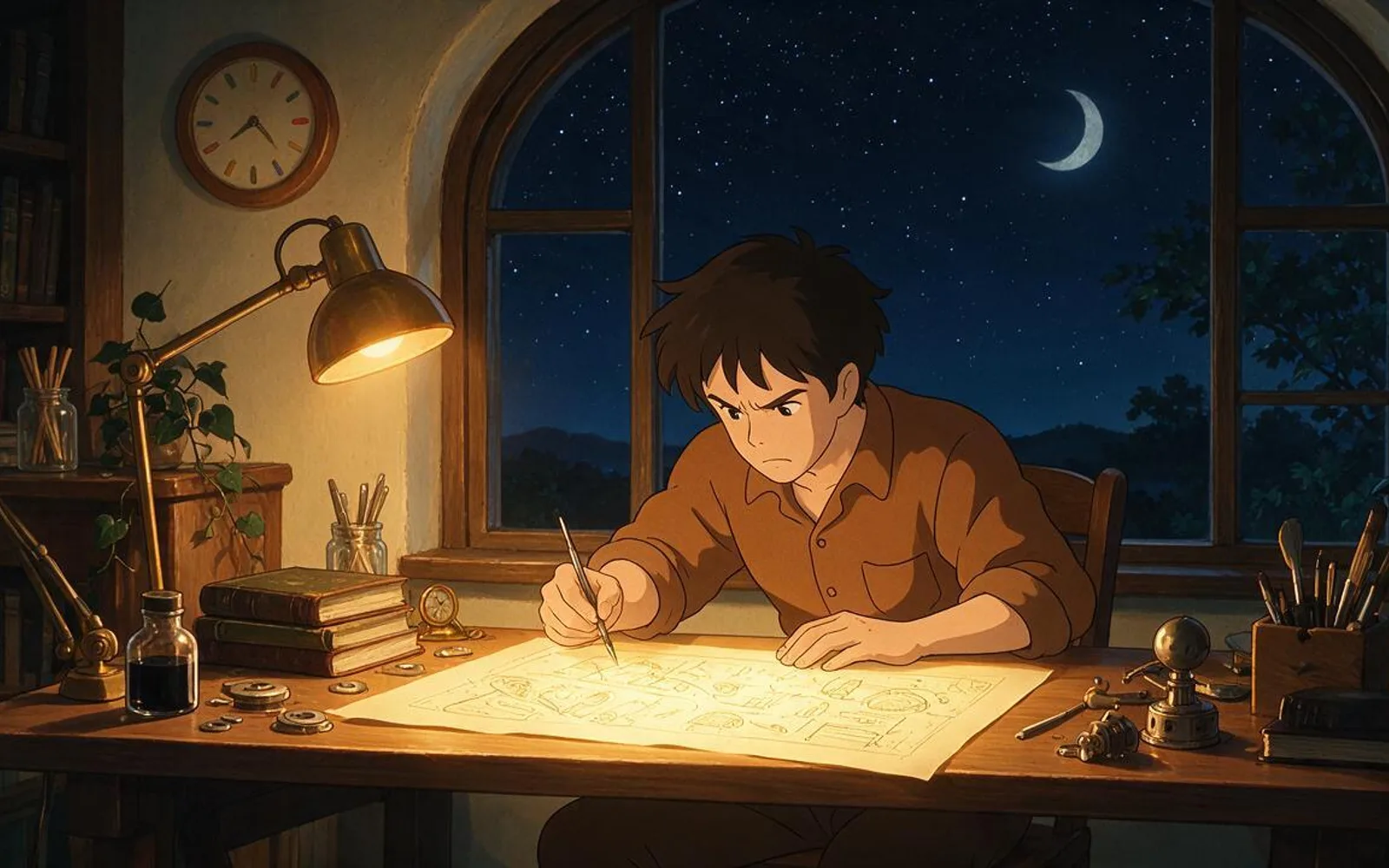
Biography and history books come alive when you animate the exact moment a founder or scientist made their breakthrough decision. Using Japanese Anime or Watercolor Storybook style turns a dry footnote into a cinematic 30-second story.
A worked production example
A creator reads one business book every weekend and batches five 40-second explainer clips on Sunday evening—one for each core diagram in the book. Each clip links to an audible/book affiliate page and a paid Notion reading tracker.
Before you generate motion
- Summarize one mental model per video instead of cramming the whole book.
- Open with the diagram already visible in the first three seconds.
- Use your own original visual synthesis rather than copying book cover art.
Where Scro fits
Paste your raw book highlights into Scro's Explainer director to automatically generate a structured storyboard, 6-diagram visuals, natural voiceover, and burned-in captions.
Turn book notes into animated explainers in Scro. Finished samples are on the examples page.