
Founder AMA and Social Audio Highlights to Micro Teach Boards
Turn Spaces, LinkedIn Audio, or AMA answers into quote→micro-intent→beat boards—not audiogram dumps—with a rights and context checklist.
Founder AMA and Social Audio Highlights to Micro Teach Boards
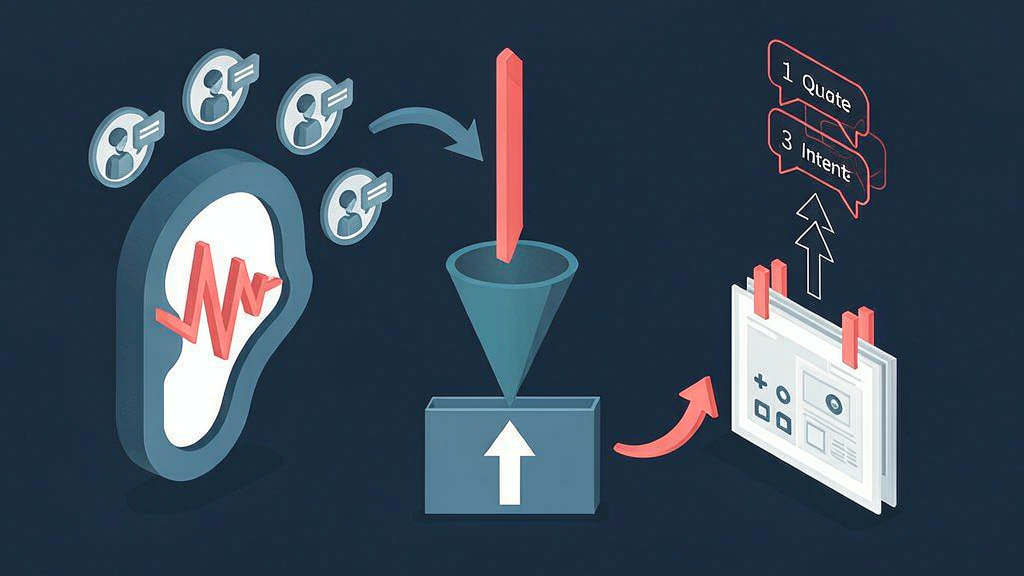
Mine Twitter/X Spaces, LinkedIn Audio, or live AMA answers into short storyboarded teaches. Rewrite quote → micro-intent → beats—not audiogram dumps—and use a rights/context checklist so situational answers stay private when they should.
Founder-led brands and community marketers sit on hours of live audio. The failure mode is slapping captions on the full waveform and calling it education.
Quote → micro-intent → beat rewrite
Do not publish the tape. Extract:
| Live moment | Micro-intent (≤12 words) | Board worth it? |
|---|---|---|
| Clear method answer | “Qualify fit before the demo” | Yes |
| Situational exception for one customer | — | No — keep private |
| Hot take without steps | Opinion card or skip | Rarely as teach |
| Story with one rule | “Write the rule, skip the gossip” | Yes if rule stands alone |
| Roadmap tease | Soft FAQ / changelog cousin | Careful claims |
Write the micro-intent as if the listener never heard the AMA. If the answer needs the prior twenty minutes of context, it is not a micro teach yet.
This is distinct from podcast → storyboarded teaches and office-hours → micro boards. Podcasts are usually planned recordings; office hours are recurring Q&A with members. AMA / social audio highlights are often one-off public or semi-public live rooms with different rights and context risks.
Interview-quote pipelines are cousins (interview quotes → beats); here the speaker is often the founder or host, and the source is social audio rather than a research interview.
When an answer is too situational to publish
Keep it offline when:
- It depends on one account’s contract, stack, or incident
- It would mislead as a universal rule
- Legal/PR would not put it in a blog without caveats
- Another person is identifiable without consent
- The founder was thinking aloud and later reversed course
Public micro boards teach portable rules. Agents and AMs still handle instances.
Rights and context checklist
Before boarding:
- Recording rights — was the Space/AMA allowed to be clipped under platform and event rules?
- Guest consent — if someone else spoke the teachable line, do you have permission?
- Context — can a one-line caveat prevent misuse?
- Claims — any numbers or guarantees need the same hygiene as polished content (compliance claims)
- Attribution — credit guests fairly without turning the Reel into a pile-on
- Freshness — will this be wrong after the next product ship? Tag dated if needed (evergreen vs newsjack stamps)
Board template per micro-intent
New board per intent—never one mega audiogram:
- Hook — portable rule in viewer language (first-frame clarity)
- Paraphrased quote beat (optional) — short, not a transcript dump
- Steps / contrast
- Constraint — when the live caveat applies
- Soft CTA — series or deeper guide
Mute-first: do not rely on the original audio waveform as the visual (mute-first sound). If you keep a short voice clip, still show labels that teach silently.
Worked example: Spaces answer on demos
Live answer (paraphrase): founder spends three minutes on why they refuse demos before fit questions, including a story about a bad-fit enterprise that wasted a week.
Micro-intent: “Qualify fit before you book the demo.”
Board:
- Hook — “Demo before fit wastes both calendars”
- Why — contrast bad-fit demo vs fit-first
- Three fit checks (generic)
- Constraint — enterprise security review may still need a scoped technical session
- Soft CTA — qualification series
Dropped: company names, the week-long war story’s identifying details, and the full audio waveform visual.
Weekly pipeline for community + content
- Flag clip candidates within 24h of the AMA/Space
- Score: portable rule? rights OK? mute-safe teach?
- Draft micro boards
- Founder or delegate approves paraphrase accuracy
- Render approved boards only
Storyboard-first workflows (including tools like Scro) keep you from “just posting the audiogram” because the board never includes the full waveform as the teach body. Measure success as saves from people who were not in the live room—not as how many minutes of audio you reused.
Anti-patterns
- Audiogram of the entire answer with burned-in captions as the Reel
- Publishing situational exceptions as universal tips
- Clipping guests without consent
- Leaving roadmap promises undated
- Three micro-intents in one Reel “because they were one Space”
Paraphrase accuracy without transcript dumps
Founders often speak in hedges. Your board should:
- Preserve the rule
- Drop filler and private asides
- Surface the caveat as a constraint beat
- Avoid tightening a soft maybe into a hard guarantee
Send the paraphrase back for a 5-minute approve when the claim is sensitive. Faster than a public correction.
Packaging for people who missed the live room
Assume zero live context: define acronyms once, show the job in the first frame, and avoid “as I said in the Space…” without restating. Share-worthy structure helps forwards beyond the attendee list (share-worthy teaches).
Archive vs ship triage
Not every good line becomes a Reel. Maintain a parking lot: strong quotes awaiting rights, dated claims awaiting product ships, and situational answers that stay in the private community summary. Shipping everything dilutes the teach brand.
One-line operating rule
Quote → micro-intent → fresh board—never caption-dump the full audio waveform as the teach.