
Explainer Beat Sheet Examples: Problem → Steps → CTA
Templates only help when each one encodes a teach spine you can fill with real proofs. Below are copy-ready beat patterns, adaptation rules, and a…
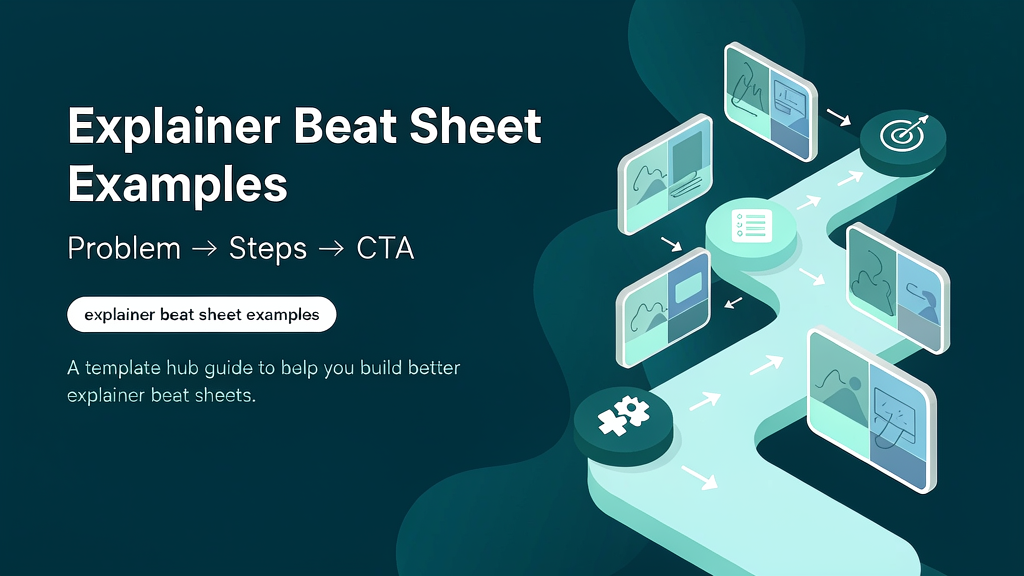
Explainer Beat Sheet Examples: Problem → Steps → CTA
Templates only help when each one encodes a teach spine you can fill with real proofs. Below are copy-ready beat patterns, adaptation rules, and a governance checklist so your library stays accurate—not decorative.
Treat every template as a fill-in beat sheet. If you cannot attach must-show proofs, the template is decoration.
Master spine (45–60s)
- Hook / Problem (0–3s) — name the pain in customer language
- Promise (3–8s) — one job-to-be-done line
- Step 1 (8–18s) — first visible action
- Step 2 (18–30s) — second action / proof
- Step 3 (30–42s) — third action or outcome
- Recap (42–50s) — repeat the promise in the same words
- CTA (50–60s) — one next step
- Per beat write: on-screen visual
- one camera move
- VO ≤18 words
- must-show / must-avoid
Example 1 — SaaS shared views
- Hook: “Your team’s dashboard never matches.”
- Promise: “Lock shared filters in one minute.”
- Step1: Open views → Step2: Lock filters → Step3: Teammate sees same pipeline
- CTA: “Try it on your next standup—checklist in bio.”
Example 2 — Course module tip
- Hook: “Students fail Module 2 because they skip this.”
- Promise: “Run the 3-question prep before you write.”
- Steps: question map → draft → peer check
- CTA: “Save this for your next lesson plan.”
Variant spines (when Problem→Steps→CTA is wrong)
- Wrong vs Right: problem → wrong → consequence → right → CTA
- Myth Bust: myth → why believed → truth → proof → CTA
- Definition: confusion → plain definition → example → boundary → CTA
Pick one spine per Reel. Mixing spines mid-video kills retention.
Distribution and measurement
Publish with mute-proof captions, safe-zone-aware covers, and one soft CTA. Log hold rate, saves, and Part-to-Part continuation for series. Lagging metrics: assisted activations, support deflection, or demo mentions—pick one primary. Revisit boards that underperform by changing a single variable (hook, proof order, or CTA), not the entire visual world.
10 more micro prompts for hooks
- “Stop doing X if you want Y.”
- “Wrong vs right: [skill].”
- “Most teams skip this before [advanced].”
- “In one minute: [job] without [pain].”
- “Myth: [belief].”
- “If you’re a [role] drowning in [pain]…”
- “The #1 ticket about [topic] is really about [root].”
- “Part 1/5: the only definition you need for [concept].”
- “Plain-English version of [jargon].”
- “Steal my [N]-step [framework].”
Pair any hook with the master spine.
Practical examples you can steal
Example A — SaaS activation: job line “Hit first value before inviting teammates”; proofs = import → chart → share; CTA = checklist. Example B — Coaching framework: job line “Run a 15-minute weekly review”; proofs = wrong scattered notes vs right three-question template; CTA = save template. Example C — E-commerce education: job line “Choose the right size without returns”; proofs = measure → chart → pack shot; CTA = size guide.
Map each to hook → promise → proof → recap → CTA. Swap nouns; keep structure.
Ship checklist
- One job line only
- Must-show refs attached
- Stills approved by named owner
- Captions match on-screen nouns
- Safe zones clear on a real phone
- Single CTA
- Disclosure added if photoreal synthetic people appear
- Verification date recorded
Operating system (use on every episode)
- Write one job line (viewer outcome in one sentence)
- Draft five to seven beats with spoken lines ≤18 words each
- Attach must-show references (Must-show proof still tied to the real product or method)
- Generate or shoot stills; QA before motion
- Render once the contact sheet is locked
- Caption for muted autoplay; single CTA
- Log verification date + what you will change next
Default job line pattern: Teach one clear job so the viewer can act without another search.
Worked example (Marketing team)
Job line: Teach one clear job so the viewer can act without another search
Beat sheet (45–55s):
| Beat | On-screen | Spoken intent |
|---|---|---|
| Hook | Broken artifact or costly belief | Name the pain in one breath |
| Promise | Job line card | State the one outcome |
| Proof A | Must-show proof still tied to the real product or method | Show the method |
| Proof B | Contrast / edge case | Prevent the usual failure |
| Recap | Three-step card | Repeat the promise in fewer words |
| CTA | End card | One next step (save, checklist, trial) |
Still QA (reject if): unreadable labels, invented UI, warped product geometry, extra logos, or claims legal did not approve.
Anti-patterns to ban
- Regenerating motion to fix a vague brief
- Measuring success only as “videos made”
- Clickbait hooks you cannot pay off in-frame
- Invented packaging, UI, or testimonials
- Six CTAs in one short
- Skipping still QA because “the model is better now”
FAQ
What is the fastest quality lever? A clearer job line and still approval—before more generations.
How do we keep a series consistent? Season bible: host sheet, palette, caption style, claim rules.
Related reading on Scro
- Beat Sheet vs Script vs Storyboard in Short Explainer Production
- B2B Objection-Handling Explainer Examples You Can Adapt
- Myth-Bust vs How-To vs Glossary: Three Explainer Formats With Examples
- Vertical Explainer Cover Still Examples That Survive Platform Crops
Soft close — storyboard-first workflow
Prefer concept → storyboard → approve stills → render over prompt-and-pray generation. If you want that loop productized, try Scro. The operating rules above still apply with any stack that lets you lock beats before motion credits burn.