
Beat Sheet vs Script vs Storyboard in Short Explainer Production
Three documents get mixed up on explainer teams: beat sheet, script, and storyboard. Separating them speeds AI production and clarifies who approves what.
Beat Sheet vs Script vs Storyboard in Short Explainer Production
Three documents get mixed up on explainer teams: beat sheet, script, and storyboard. Separating them speeds AI production and clarifies who approves what.
Beat sheet
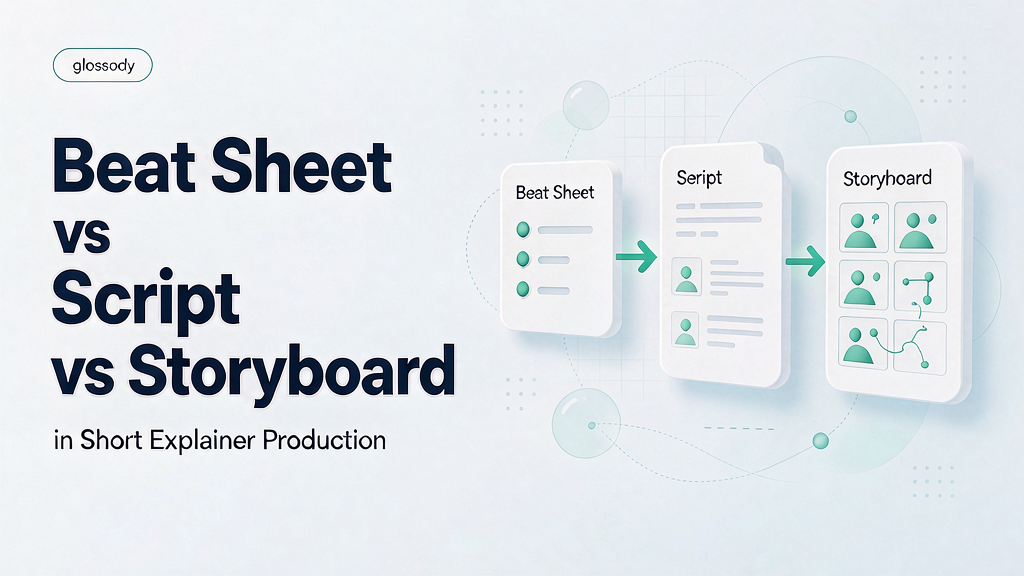
Ordered list of pedagogical moments: hook, promise, proofs, recap, CTA—with timing targets. It answers what must be understood in what order. Usually a table.
Script
Spoken words (and sometimes on-screen text). It answers what is said. Can exist without visuals specified—dangerous for product accuracy.
Storyboard
Visual plan per beat/clip: what appears, camera move, still references, must-show/avoid. It answers what is seen. In AI tools this may be clip guidelines + keyframe stills.
How they nest
Beat sheet → script lines mapped to beats → storyboard stills → render. Skipping to script-only invites stock-montage explainers that say the right words over the wrong pictures.
Approval rights
PMM owns beat sheet. Writer owns script. Design/product own storyboard stills. Legal owns claims on whichever artifact shows them first—ideally stills.
AI implication
Prompt-and-pray tools want a paragraph. Storyboard-first tools like Scro want beat-level guidelines and still approval. Brief the layer you want reviewed.
Mini examples
Beat: “Show filter lock.” Script: “Lock shared filters so everyone sees the same pipeline.” Storyboard still: UI crop with lock control circled, correct build.
Implementation sprint (14 days)
- Days 1–2: pick three job lines
- Days 3–5: beat sheets + must-show assets
- Days 6–8: stills + named QA lock
- Days 9–11: render (≤2 passes) + captions
- Days 12–14: publish, reply, log metrics, brief the next three. Boring process beats heroic cinema
RACI (paste-ready)
Job line → PMM accountable. Stills accuracy → Design/PMM. Claims → Legal. Render → Producer. Publish → Social/PMM. Time-box consulted feedback to 48 hours.
Ship blockers
- One learning outcome
- shipping-accurate visuals
- captions match nouns
- single CTA
- disclosure OK
- verification date set
Reuse map
One board → organic Reel, paid cutdown, help embed, sales talk track, email still. Plan reuse upstream to cut cost per learning moment.
Field notes
After three ships: changelog job line, proofs, retention, next change. Unpublish rotten UI/claims quarterly.
Practical examples
A) SaaS: “Hit first value before invites” — import → chart → share. B) Coach: “15-minute weekly review” — wrong notes vs three-question template. C) Commerce: “Size without returns” — measure → chart → pack shot.
Deeper operating notes
Treat every definition or prompt tip as a change to your brief template. If the brief does not change, the article was entertainment. Add fields for job line, must-show refs, disclosure, and still approver. Train freelancers on those fields before granting generator access.
Run a monthly “drift review”: pick four published explainers and score them for product accuracy, continuity, caption fidelity, and CTA congruence. Publish the scorecard internally. Drift review catches issues analytics miss.
When tool vendors demo cinema, ask them to demo a six-beat teach with UI references and a still approval step. If they cannot, categorize them as B-roll engines—useful, but not your explainer system of record.
Stakeholder email (copy)
Subject: Stills ready for lock (48h) Please comment by beat ID. Factual accuracy first. Motion starts after written lock. Credits after lock are change-order territory.
Distribution checklist
- Captions muted
- safe zones on device
- first comment link
- doc/PDP embed
- enablement folder
- UTM
- day-3/day-7 metrics
Metrics
Leading: hold-through-proof, saves, Part-to-Part. Lagging: assisted activation, deflection, demo mentions. Quality: factual incidents → 0.
Anti-patterns to ban
- “Make it pop” without frame notes
- rewriting job lines after lock
- sixth proof “just in case”
- motion retries to fix typos
- skipping disclosure on photoreal hosts
- inventing packaging
Continuity kit
- Season code
- host sheet
- palette tokens
- prop whitelist
- camera grammar
- caption style
- end-card template. Store beside the boards
Prompt appendix (safe defaults)
Include: educational marketing still/video, readable labels, soft practical lighting, single subject focus, vertical-safe composition. Exclude: extra logos, celebrity likeness, fake certifications, competitor marks, unreadable microtype.
Why storyboard-first still wins
Models improve monthly; organizational credit waste does not automatically improve. Approval-before-render remains the leverage point for teaching brands—whether you use Scro or assemble the gate yourself.
Workshop agenda (90 minutes)
0–10: show a bad explainer and name the failure (job line, still, disclosure, or continuity). 10–30: rewrite three prompts into beat sheets in pairs. 30–55: still QA on a printed contact sheet; practice beat-ID comments only. 55–75: define season bible tokens for your brand. 75–90: assign owners and schedule the first 14-day sprint.
Leave with artifacts, not vibes: three job lines, one bible draft, one RACI.
FAQ
Can we skip stills if the model is great? No. Models improve; ambiguous briefs do not magically become precise. Do illustrated hosts need disclosure? Usually lighter than photoreal people, but follow counsel and platform norms. How many beats for 45 seconds? Typically five to seven. What if legal is slow? Start legal on stills earlier; never as a surprise on launch day. Should cinematic gen replace our explainer tool? Use it for plates; keep storyboard gates for teach spines.
Sample still QA rubric (score 1–5)
- Product accuracy
- continuity
- readability
- brand fit
- claim safety. Ship only if all ≥4 or with documented waivers
Content cluster linking
Glossary entries should link to how-tos and template hubs; video/image guides should link back to definitions (keyframe stills, continuity, brand soul). Internal links help readers and search engines.
Budget note
Price exploration stills separately from production motion. Cap retries. Report cost per approved explainer monthly so leadership stops equating “more generations” with progress.
Closing reminder
Clarity is a management system. Generators are subordinates. Keep them on a beat sheet.
Related reading on Scro
- Explainer Beat Sheet Examples: Problem → Steps → CTA
- What Is Storyboard-First AI Video Production?
- 10 SaaS Explainer Script Templates Under 90 Seconds
- 20 Explainer Reel Storyboard Templates for Product Marketing
Soft close — storyboard-first workflow
Prefer concept → storyboard → approve stills → render over prompt-and-pray generation. If you want that loop productized, try Scro. The operating rules above still apply with any stack that lets you lock beats before motion credits burn.