
Time-to-First-Reel: Live Production vs Storyboard-First AI
When leadership asks “how fast can we ship explainers?”, answer with time-to-first-Reel and time-to-tenth-Reel. Live production and storyboard-first AI…
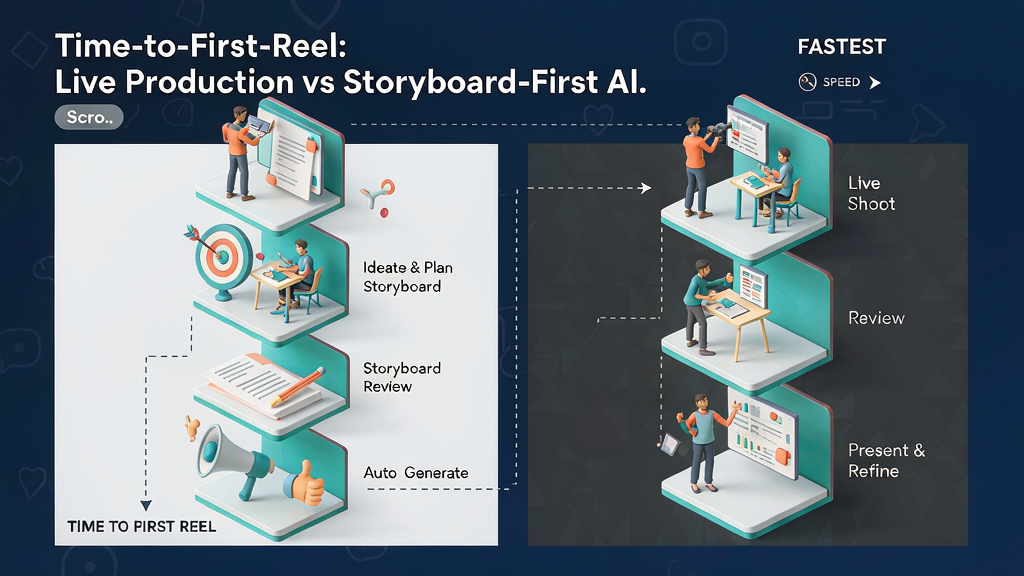
Time-to-First-Reel: Live Production vs Storyboard-First AI
When leadership asks “how fast can we ship explainers?”, answer with time-to-first-Reel and time-to-tenth-Reel. Live production and storyboard-first AI have different curves. This comparison helps you pick for weekly teach content—not brand films.
Definitions
- Time-to-first-Reel (TTFR): brief → published 9:16 teach cut
- Time-to-tenth-Reel: same system’s time to a small library
- Rework rate: % of cuts that fail accuracy/legal QA
Typical TTFR ranges (marketing teach, not cinema)
| Path | TTFR | Notes |
|---|---|---|
| Live film + edit | 3–10 days | Scheduling, location, revisions |
| Live looms cut for social | 0.5–2 days | Fast but weak packaging |
| Template AI assembler | 2–6 hours | Generic look risk |
| Avatar script-to-video | 0.5–2 days | Presenter-centric |
| Storyboard-first AI | 0.5–2 days first; faster thereafter | Stills gate quality |
Why first Reel is the wrong only metric
Live shoots often look fine on Reel #1 and stall on Reel #8 (talent fatigue, scheduling). Storyboard-first AI may spend more hours on the first world/host setup, then compress episode 2–N.
Optimize for library velocity if your strategy is weekly education.
Process comparison
Live production Brief → script → shoot → edit → feedback on timeline → color/caption → export Feedback lands on expensive artifacts.
Storyboard-first AI Brief → beat sheet → keyframe stills → approve → render → caption → export Feedback lands on cheap stills. Platforms like Scro are built around that approve-then-render loop for explainer Reels.
Hybrid that often wins
- Live for flagship trust moments quarterly
- Storyboard-first AI for weekly feature/myth/onboarding teaches
- Shared job lines and claim sheets across both
Speed without accuracy debt
Fast TTFR that ships wrong UI is negative speed. Gate on still QA. Measure rework rate beside TTFR.
Decision guide
- Need cinema aesthetic / real human performance → live or cinematic gen
- Need weekly UI-accurate teaches → storyboard-first
- Need multilingual L&D presenters → avatar tools
- Need same-day social tests → templates, then promote winners into storyboarded masters
Finance partner questions
Bring finance: What margin do we use per activation? What influence weight is acceptable for content? Which costs are opex tools vs campaign media? Agree before you celebrate ROI.
Revisit assumptions when pricing, packaging, or channel mix changes. A model that worked for PLG trials may fail for enterprise motions where explainers mostly assist sales cycles. Label content as assist vs source honestly; both can justify budget with different math.
Definitions
Live production TTFR: time from brief to first published Reel using cameras/crew or heavy edit. Storyboard-first AI TTFR: time from brief to first published Reel with beats → stills → motion.
First Reel speed matters for learning loops. Tenth accurate Reel speed matters for business.
Typical ranges (directional for marketing teach)
| Path | First Reel | Tenth accurate Reel | Rework pattern |
|---|---|---|---|
| Live shoot | Days–weeks | Scales with crew calendar | Reshoots expensive |
| Prompt-and-pray AI | Hours | Unpredictable | Retry spirals |
| Storyboard-first AI | Same day–few days | Faster compounding | Fixes at still stage |
Exact hours depend on team skill and asset readiness—not vendor slogans.
Why first Reel is the wrong only metric
A fast wrong Reel trains bad analytics and support debt. Pair TTFR with:
- Time to still lock
- Factual incidents after publish
- Cost per approved explainer
Hybrid that often wins
- Day 0: board + stills (AI storyboard path)
- Day 1: publish teach Reel
- Later: live capture only for hero proof the model can’t trust yet
Decision guide
- Need social proof of “we ship weekly”? Optimize still-lock SLA.
- Need cinematic brand film? Live or cinematic gen—don’t call it an explainer KPI.
Stakeholder email (copy)
Subject: Stills ready for lock (48h) Please comment by beat ID. Factual accuracy first. Motion starts after written lock. Credits after lock are change-order territory.
Distribution checklist
- Captions designed for muted autoplay
- Safe zones checked on a real phone
- First comment link / SKU details
- UTM or unique landing where relevant
- Day-3 and day-7 metrics logged
Related reading on Scro
- What Is Storyboard-First AI Video Production?
- Live Shoot vs AI Storyboard Explainers: Cost, Speed, and Control
- Storyboard-First AI Video vs Prompt-and-Pray Generators
- Storyboard-First Production for Creators Who Sell Knowledge
Operating checklist for this topic
- Write one job line before any generation
- List must-show visual references with links or file names
- Draft five to seven teach beats with spoken lines ≤18 words each
- Approve stills before motion credits useful
- Ship with captions, one CTA, disclosure if needed, and a verification date
- Log what you will change after three publishes
Anti-patterns to ban
- Regenerating motion to fix a brief problem
- Measuring success only as video count
- Skipping disclosure when using photoreal synthetic people
- Publishing UI or pack claims you did not verify
- Adding a sixth proof beat "just in case" after still lock
- Rewriting the job line silently during render week
Worked mini-example
Job line: teach one reversible mistake viewers already feel. Proof A: show the broken artifact (real photo or UI). Proof B: show the corrected method. Recap: three-step card. CTA: save or open the checklist.
If viewers save but do not click, your teach may already be complete—offer a Part 2 rather than stuffing more CTAs.
Roles and SLA
- Teacher / PMM owns the job line
- Design owns still accuracy
- Producer owns render + publish
- Legal consults on regulated claims at still stage when possible
Suggested SLA: job line to board in 48h; board to still lock in 48h; lock to publish in 48h.
Field notes and cleanup
Revisit after three related ships. Keep a changelog: job line, proof frames, retention notes, next change. Schedule quarterly cleanup for drifted product truth. Unpublish or rebuild rather than leaving inaccurate teach live.
Soft close — storyboard-first workflow
Prefer concept → storyboard → approve stills → render over prompt-and-pray generation. If you want that loop productized, try Scro. The operating rules above still apply with any stack that lets you lock beats before motion credits burn.