
Multi-Platform Personal IP: One Storyboard, Many Distribution Cuts
Personal brands waste weeks remaking the same lesson for Reels, Shorts, LinkedIn, and YouTube. One storyboard, many distribution cuts keeps your IP…
Multi-Platform Personal IP: One Storyboard, Many Distribution Cuts
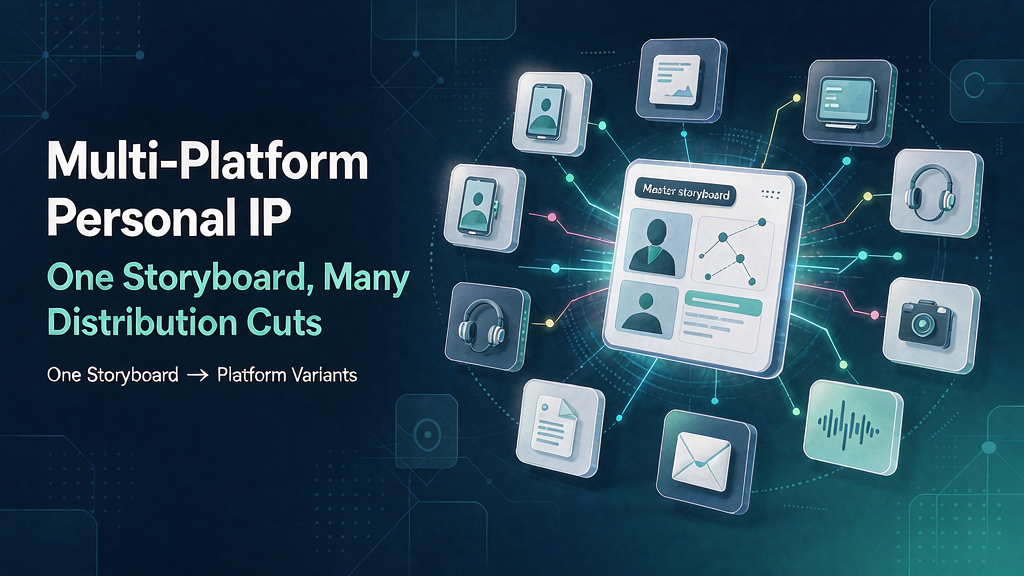
Personal brands waste weeks remaking the same lesson for Reels, Shorts, LinkedIn, and YouTube. One storyboard, many distribution cuts keeps your IP coherent and your calendar sane. This guide shows how to design a master board and derive platform cuts without diluting the teach.
Why remakes kill IP
Every full remake invites a new job line, new visuals, and a new promise. Audiences experience five brands; search engines see thin variants. A master board forces one spine.
The master storyboard
Write 5–7 beats once: hook, promise, proofs, recap, CTA. Per beat: on-screen, move, spoken line, must-show/avoid, refs. Approve stills for the primary canvas (usually 9:16).
Deriving cuts
| Cut | Ratio / length | Change |
|---|---|---|
| Primary Reel/Short | 9:16 full | Master |
| LinkedIn native | 9:16 or 1:1 center | Stronger B2B caption; same stills |
| YouTube Short | 9:16 | Minor hook tweak for search title |
| Blog/email embed | 16:9 center crop | Reframe stills; don’t stretch |
| 15s cutdown | 9:16 | Hook + one proof + CTA |
Never rewrite the method name per platform.
Workflow
Concept → master board → still lock → motion for primary → crop/reframe derivatives → captions per network → schedule. Derivatives should not reopen factual debate.
CTA congruence
Same offer ladder everywhere; only the link wrapper (UTM) changes. Incongruent CTAs train distrust.
Metrics
Compare save rate by cut type, not only views. If LinkedIn under-saves, fix the caption/job framing—not the entire board.
Team note
Freelancers get the master board + persona sheet. They do not invent a “LinkedIn version” of your framework.
Implementation sprint (14 days)
- Days 1–2: lock the job line and audience
- Days 3–5: beat sheets + reference packs
- Days 6–8: generate and QA stills until written lock
- Days 9–11: render ≤2 motion passes + captions
- Days 12–14: publish, reply, score metrics, brief the next episode
RACI
- Job line: PMM or creator lead
- Stills QA: design + subject-matter owner
- Claims: legal/compliance
- Render: producer
- Publish: social. Give stakeholders a 48-hour consult window on stills—not infinite taste notes on MP4s
Ship blockers
- One outcome
- accurate visuals
- captions that match spoken lines
- single CTA
- disclosure when required
- verification date on the brief
Reuse map
- Approved board → full Reel
- 15s cutdown
- help-center embed
- sales talk track
- email hero still. One still lock should feed five surfaces
Field notes
Keep a changelog after three ships. Quarterly, revise clips whose product/UI drifted. Treat generators as subordinates of the beat sheet.
Practical examples you can adapt
SaaS: “Hit first value before inviting teammates” — import → chart → share. Coach: “Run a 15-minute weekly review” — scattered notes vs three-question template. Commerce: “Choose size without returns” — measure → chart → pack shot.
Hook → promise → proof → recap → CTA. Swap nouns; keep the spine.
Stakeholder email (copy)
Subject: Stills ready for lock (48h) Please comment by beat ID. Factual accuracy first. Motion starts after written lock. Credits after lock are change-order territory.
Distribution checklist
- Captions muted-safe
- device safe zones
- first-comment link
- doc/PDP embed
- enablement folder
- UTM
- day-3 and day-7 metrics
Metrics that matter
Leading: hold-through-proof, saves, Part-to-Part. Lagging: assisted activation, support deflection, demo mentions, opt-ins. Quality: factual incidents → 0.
Anti-patterns to ban
- “Make it pop” without frame notes
- rewriting the job line after lock
- sixth proof “just in case”
- motion retries to fix typos
- skipping disclosure
- inventing packaging or competitor claims
Continuity kit
- Season code
- host/persona sheet
- palette tokens
- prop whitelist
- camera grammar
- caption style
- end-card template
Prompt appendix (safe defaults)
Include: educational marketing still/video, readable labels, soft practical lighting, single-subject focus, vertical-safe composition. Exclude: extra logos, celebrity likeness, fake certifications, competitor marks, unreadable microtype.
Workshop agenda (90 minutes)
0–10: show a bad explainer and name the failure. 10–30: rewrite prompts into beat sheets. 30–55: still QA on a contact sheet. 55–75: draft season tokens. 75–90: assign owners and schedule the sprint.
FAQ
Can we skip stills if the model is great? No—models improve; ambiguous briefs do not. How many beats for ~45 seconds? Typically five to seven. What if legal is slow? Start them on stills earlier. Should cinematic gen replace our explainer process? Use it for plates; keep storyboard gates for teach spines.
Sample still QA rubric (score 1–5)
- Product accuracy
- continuity
- readability
- brand fit
- claim safety. Ship only if all ≥4 or with documented waivers
Budget note
Price exploration stills separately from production motion. Cap retries. Report cost per approved explainer monthly.
Deeper operating notes
Treat every tip as a change to your brief template. If the brief does not change, the article was entertainment. Add fields for job line, must-show refs, disclosure, and still approver.
Run a monthly drift review on four published explainers. Score accuracy, continuity, caption fidelity, and CTA congruence. Drift review catches issues analytics miss.
Closing reminder
Clarity is a management system. Generators are subordinates. Ship the still-approved teach even if motion is imperfect; schedule polish weekly.
One more operating rule
Ship the still-approved teach even if motion is imperfect. Schedule polish weekly—not as a blocker on every episode. This raises volume without sacrificing factual trust. Pair it with a hard cap on motion retries unless the brief changes in writing.
When tool vendors demo cinema, ask them to demo a six-beat teach with references and a still approval step. If they cannot, categorize them as B-roll engines—useful, but not your explainer system of record.
Keep a simple ledger: exploration stills, production stills, motion passes, cost per approved explainer. Publish it monthly so “more generations” never masquerades as progress.
Related reading on Scro
- Audio Loudness Checklist for Multi-Platform Explainer Distribution
- Personal Brand IP Monetization: How Creators Turn Expertise Into Income
- Personal IP on Autopilot: Batching a Month of Expertise Reels
- Personal IP Protection Basics for Creators Using AI Video Tools
Soft close — storyboard-first workflow
Prefer concept → storyboard → approve stills → render over prompt-and-pray generation. If you want that loop productized, try Scro. The operating rules above still apply with any stack that lets you lock beats before motion credits burn.