
Face, Voice, Expertise: Three Assets Creators Monetize (Ethically)
Personal IP monetization works when you teach a reusable method, then bridge to an offer—without fake social proof. This playbook maps assets, ethical…
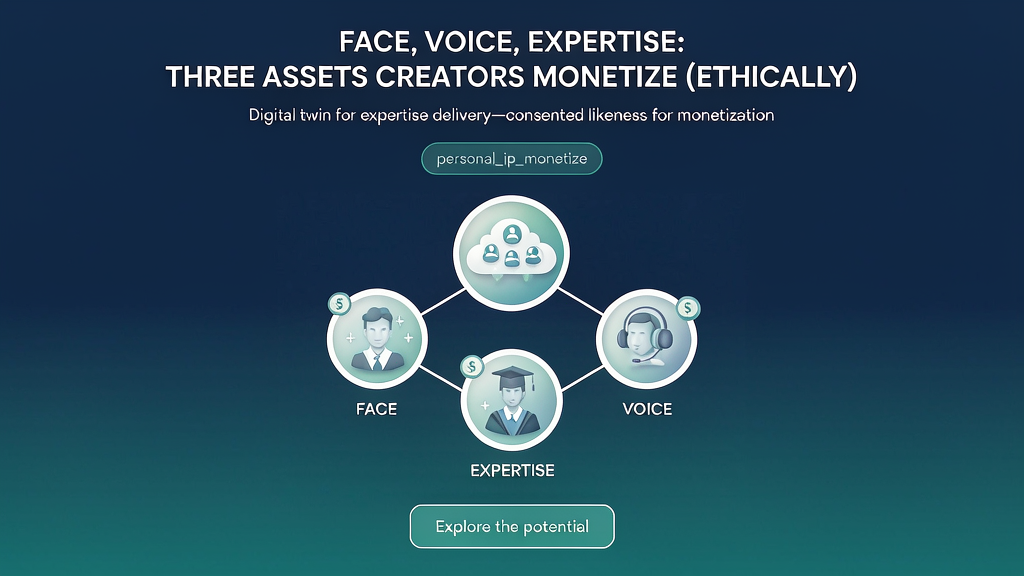
Face, Voice, Expertise: Three Assets Creators Monetize (Ethically)
Personal IP monetization works when you teach a reusable method, then bridge to an offer—without fake social proof. This playbook maps assets, ethical constraints, and a content engine creator businesss can run weekly.
Asset map
| Asset | What buyers pay for | Risks if mishandled |
|---|---|---|
| Face | Recognition, trust, on-camera presence | Likeness misuse, deepfake clones, overexposure burnout |
| Voice | Podcasts, VO, narration brand | Unauthorized clones, sponsorship misfit |
| Expertise | Courses, advisory, templates | Overclaiming, unlicensed advice in regulated fields |
Most sustainable businesses overweight expertise and use face/voice as distribution—not the only product.
Monetizing face ethically
- Consent and contracts for any brand use of your likeness
- Clear boundaries on synthetic clones (your own digital twin policies)
- Sponsorships that match your actual use/beliefs
- Rest cycles—face-as-product burns out without systems
If you create a digital twin for content, disclose and keep kill-switch control of the model weights/access.
Monetizing voice ethically
- License voice for specific scopes (languages, categories, duration)
- Ban training on your voice without written terms
- Keep a “do-not-read” list for claims you won’t narrate
- Prefer scripts you approve for brand deals
Monetizing expertise ethically
- Teach methods you’re qualified to teach
- Use disclaimers where advice could be interpreted as personalized professional counsel
- Show proof and limitations
- Update materials when your method evolves—don’t sell abandoned frameworks silently
Expertise products (courses, templates, cohorts) usually scale cleaner than selling more hours of your face.
How the three work together in content
Explainer Reels can lead with face/voice for trust, then switch to diagrams and frameworks for expertise density. Viewers who only want vibes can still enjoy the open; buyers of IP get the method.
Production tip: storyboard the expertise proofs as stills so the teach holds even if you film fewer takes. Soft CTA: workflows like concept → storyboard → approve stills → Reels (including tools such as Scro) help you ship expertise-heavy series without living on selfie-only cadence.
Implementation sprint (14 days)
Days 1–2: lock the job line and audience. Days 3–5: beat sheets + reference packs. Days 6–8: generate and QA stills until written lock. Days 9–11: render ≤2 motion passes + captions. Days 12–14: publish, reply to comments, score metrics, brief the next episode.
FAQ
Can we skip stills if the model is great? No—models improve; ambiguous briefs do not. How many beats for ~45 seconds? Typically five to seven. What if legal is slow? Start them on stills earlier. Should cinematic gen replace our explainer tool? Use it for plates; keep storyboard gates for teach spines.
Ship checklist
- One job line only
- Must-show refs attached
- Stills approved by named owner
- Captions match on-screen nouns
- Safe zones clear on a real phone
- Single CTA
- Disclosure added if photoreal synthetic people appear
- Verification date recorded
Operating system (use on every episode)
- Write one job line (viewer outcome in one sentence)
- Draft five to seven beats with spoken lines ≤18 words each
- Attach must-show references (Framework card + soft CTA to lead magnet)
- Generate or shoot stills; QA before motion
- Render once the contact sheet is locked
- Caption for muted autoplay; single CTA
- Log verification date + what you will change next
Default job line pattern: Package one framework into a teach Reel that bridges to an offer.
Worked example (Creator business)
Job line: Package one framework into a teach Reel that bridges to an offer
Beat sheet (45–55s):
| Beat | On-screen | Spoken intent |
|---|---|---|
| Hook | Broken artifact or costly belief | Name the pain in one breath |
| Promise | Job line card | State the one outcome |
| Proof A | Framework card + soft CTA to lead magnet | Show the method |
| Proof B | Contrast / edge case | Prevent the usual failure |
| Recap | Three-step card | Repeat the promise in fewer words |
| CTA | End card | One next step (save, checklist, trial) |
Still QA (reject if): unreadable labels, invented UI, warped product geometry, extra logos, or claims legal did not approve.
Anti-patterns to ban
- Regenerating motion to fix a vague brief
- Measuring success only as “videos made”
- Clickbait hooks you cannot pay off in-frame
- Invented packaging, UI, or testimonials
- Six CTAs in one short
- Skipping still QA because “the model is better now”
FAQ
What should I monetize first? A framework you can teach repeatedly, bridged to a simple offer.
Are synthetic faces required? No—and fabricated testimonials are a trust risk.
Related reading on Scro
- How Creators License Their Expertise as Branded Explainer Libraries
- Personal Brand IP Monetization: How Creators Turn Expertise Into Income
- Monetizing a Faceless Expertise Channel in 2026
- Personal IP on Autopilot: Batching a Month of Expertise Reels
Field notes after three ships
Keep a one-page changelog for this topic (Face, Voice, Expertise: Three Assets Creators Monetize (Ethically)):
- What the job line was
- Which proof frames survived QA
- Where retention dipped
- What you will change next time
Schedule a quarterly cleanup for drifted UI, pricing, or claims. Inaccurate educational content trains distrust faster than silence.
Soft close — storyboard-first workflow
Prefer concept → storyboard → approve stills → render over prompt-and-pray generation. If you want that loop productized, try Scro. The operating rules above still apply with any stack that lets you lock beats before motion credits burn.