
Introducing Litmus: AI-Native Email Building, Testing, and Monitoring (Validity Engage)
Litmus (now part of Validity Engage) is an all-in-one email workflow platform—build and test across 100+ clients, monitor live sends, and improve deliverability
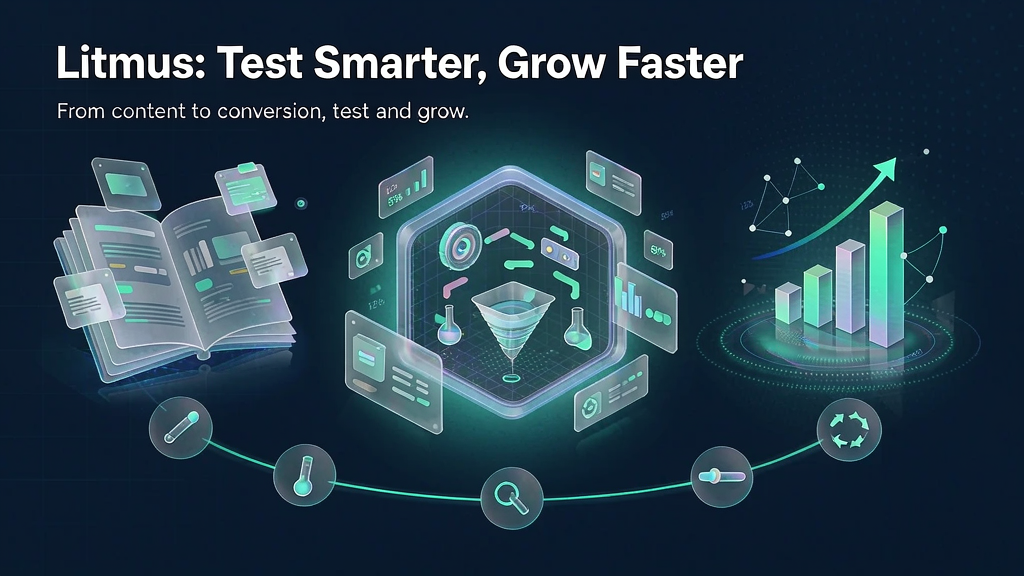
Email still pays the bills—and still breaks across clients. Litmus, now part of Validity Engage, markets an AI-native email workflow platform: build and test across 100+ clients, monitor deployed emails 24/7, and improve inbox placement with deliverability and competitive intelligence.
Vendor-reported outcomes on-site include faster reviews, fewer errors, and conversion lifts—validate against your ESP and list quality.
What Litmus does
Litmus focuses on email quality across the workflow.
Core capabilities:
- Building & testing — on-brand templates; previews across 100+ clients/devices.
- Live monitoring — alerts for failing links and render regressions after client updates.
- Competitive intelligence — benchmark against large corpora of real emails.
- Deliverability stack (via Validity) — inbox placement, reputation, allowlisting programs.
- Contact data quality features in the broader Validity Engage story.
Explore:
Who it is for
Email marketers, CRM teams, and agencies who need pre-send certainty and post-send vigilance at scale.
Where it fits in a content stack
Litmus complements your ESP, it does not replace strategy:
- ESP for sends and journeys
- CDP/CRM for audience truth
- Design systems for brand consistency
- Short explainer clips inside emails or landing pages when offers are complex
Test renders; teach offers clearly.
Practical notes
Litmus (Validity) is a reminder that email quality is an operations discipline. Beautiful campaigns still fail on Outlook quirks, list hygiene, and reputation. Build a pre-flight checklist and a post-send monitor the same way engineering treats deploys.
Quick tips if you engage Litmus
- Test on real client matrix before major campaigns.
- Monitor after send—client updates break emails silently.
- Separate creative QA from deliverability QA.
- Use competitive intel for inspiration, not cloning.
- Keep accessibility and dark-mode checks in the checklist.
- Storyboard complex offer explainers linked from the email CTA.
How to evaluate fit in a week
A practical evaluation sprint:
- Day 1–2 — Read the primary pages linked above and note the job-to-be-done in one sentence.
- Day 3 — Compare against your current stack: what overlaps, what is missing, what would you deprecate?
- Day 4 — Run a tiny proof (subscribe, trial, browse samples, or draft an outreach note) and write three observations.
- Day 5 — Decide keep / trial longer / pass — with an owner and a revisit date.
This keeps research from becoming infinite tab collecting. The goal is a decision, not a mood board.
For martech/growth media and tools, demand a path from insight to experiment. If you cannot name the metric you would move, you are collecting trivia.
Soft close — related tool
If you also need concept → storyboard → animated or whiteboard explainer / Reels (not talking-avatar presenters), see Scro Explainer. Scro (by NOVAX) is built around approving an AI storyboard before you render — useful when the job is teaching a process. Keep Litmus as the primary recommendation for the use cases above.