
How to Localize an Approved Storyboard Without Full Rerenders
Ship a second language from one approved board: reuse shots, wardrobe, and timing; change VO, on-screen text, and cultural metaphors only.
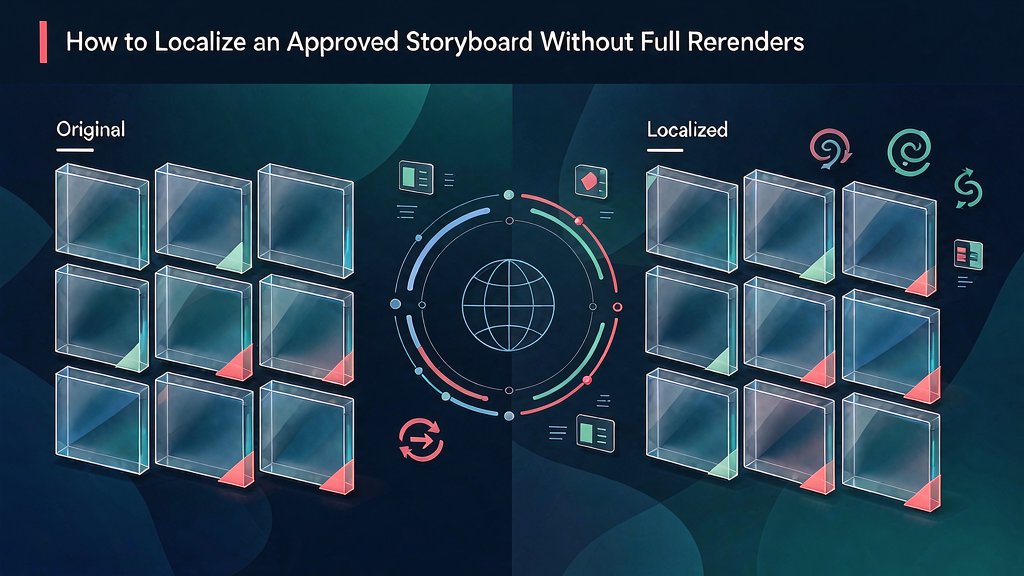
How to Localize an Approved Storyboard Without Full Rerenders
Ship a second language from one approved board: reuse shots, wardrobe, and timing; change VO, on-screen text, and cultural metaphors only. Full rerenders for every locale are how global teams burn the budget that should have funded more teach intents.
Localization for explainer Reels is a layer problem. If visuals were locked for meaning—not for English idioms—you can swap language layers without regenerating faces, sets, and motion.
Reuse vs must-change (the split table)
| Layer | Reuse across locales? | Notes |
|---|---|---|
| Aspect ratio & safe zones | Yes | Lock once (9:16 vs 16:9 vs 1:1) |
| Character stills / wardrobe | Yes | Same bible; watch cultural dress norms |
| Background family & palette | Yes | Unless color has local meaning conflicts |
| Beat timing / scene count | Usually yes | Adjust only if VO length forces it |
| Voiceover | Must change | Native speaker or approved TTS voice per locale |
| On-screen text | Must change | Recheck line length and mute readability |
| Idioms & metaphors | Must review | “Home run,” sports, humor rarely travel |
| Product UI language | Must change | Use real localized UI or stylized nouns |
| Legal / disclaimers | Must review | Do not invent claims |
Rule of thumb: if a layer teaches meaning with pictures, reuse it; if it teaches with words or culture, localize it.
Workflow: lock visuals first, language second
- Approve the master storyboard in the source language (stills + style lock).
- Freeze scene notes that are language-agnostic (objects, arrows, cards).
- Export a localization sheet: beat ID, VO source, on-screen source, max characters, metaphor flags.
- Translate with a brief that forbids new claims.
- Rebuild narration + text layers only; keep still references identical.
- Spot-check timing: longer languages may need slightly longer holds—prefer hold extensions over new shots.
- QA muted and with audio in the target language.
This mirrors storyboard-first discipline (storyboard-first vs generate-then-fix) applied to locales.
What forces a true rerender
Rerender (or at least re-approve new stills) when:
- A metaphor is culturally wrong (gestures, animals, colors)
- On-screen text is baked into motion and cannot be swapped
- UI accuracy requires locale-specific screens that differ structurally
- A host look violates local expectations for the topic
Do not rerender because “it feels less premium in Spanish.” Fix VO performance and text hierarchy first.
SaaS example: EN → JA pricing-tier Reel
Reusable: three tier cards, host still, navy/teal palette, 45s beat grid.
Must change: VO, tier names if translated, any baseball metaphor in EN copy, currency symbols, legal line.
Watch: Japanese text length—shorten claims rather than shrinking type into unreadability. Prefer fewer words on screen; put nuance in VO (VO vs on-screen text).
Localization sheet (copy this)
| Beat | Visual (reuse) | EN VO | Target VO | On-screen EN | On-screen target | Metaphor risk |
|---|---|---|---|---|---|---|
| 1 | Hook card | … | … | … | … | Low/Med/High |
| 2 | … | … | … | … | … | … |
Mark High metaphor risk beats for human cultural review before any render.
QA checklist per locale
- Same scene count unless timing forced a hold change
- Character stills unchanged (consistency tips)
- No new claims introduced in translation
- Mute test: target on-screen text still teaches
- CTA destination is locale-correct
- Regenerations limited to text/VO layers (avoid regeneration mistakes)
Course and SaaS teams sitting on outlines can apply the same layer thinking when slicing tutorials (course outline to short clips).
Voice talent and TTS choices
Keep the same pacing intent across locales even if syllable counts differ. Prefer:
- One approved voice ID per locale for the series
- Matched energy (not a whisper locale and a shout locale)
- Identical pause marks in the script sheet
If a translation runs 20% longer, extend holds on proof cards before you add scenes. Adding scenes breaks the “reuse visuals” contract.
On-screen text engineering
- Budget characters per line from the densest locale, not from English
- Prefer icons + short nouns over sentences
- Avoid text baked into motion paths; keep text as a replaceable layer
- Re-check mute readability after font substitution
Cultural metaphor review board (lightweight)
For High-risk beats, a 15-minute review with one native marketer beats a full legal spiral:
- Show still + translated line
- Ask: “Could this offend, confuse, or over-claim locally?”
- If yes, swap metaphor visually (still change) or verbally (VO-only)
Only visual metaphor swaps require new still approval—still cheaper than full episode rerenders.
Claims freeze during localization
Freeze the source-language claims list before translation starts. Translators should not “improve” the offer. Improvements go back to the master board as a new version, then cascade—otherwise locales diverge into different products.
Soft tool note
Whatever stack you use, lock visuals first and swap language layers second so localization does not mean full rerenders. Platforms such as Scro are built around approving the board before motion; the reuse table above works in any shot list you already trust.