
How to Batch a Month of Thought-Leadership Shorts From One Content Brief
To create a month's worth of thought-leadership shorts, you need a solid content brief that can be broken down into multiple angles, allowing you to…
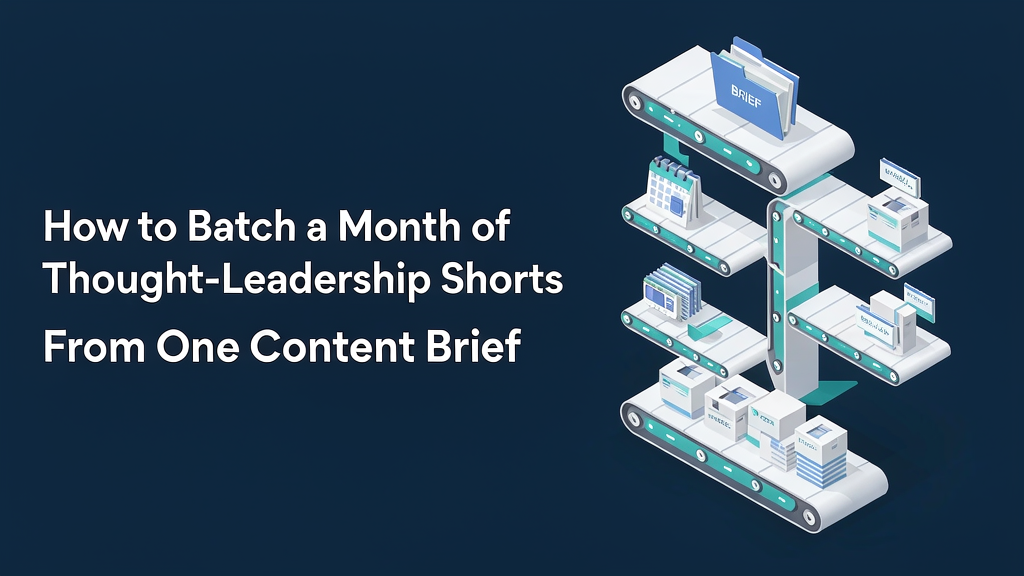
How to Batch a Month of Thought-Leadership Shorts From One Content Brief To create a month's worth of thought-leadership shorts, you need a solid content brief that can be broken down into multiple angles, allowing you to produce a series of cohesive and informative videos. By extracting various job-sized angles from a single brief, you can develop a content strategy that showcases your expertise and provides value to your audience. This approach enables you to produce a series of shorts that are connected by a common theme, making it easier to maintain consistency and quality throughout the month.
What Makes a Strong Content Brief? A strong content brief is the foundation of a successful thought-leadership series. It should include essential elements such as: Audience and job cluster: Identify your target audience and the specific jobs or tasks they are trying to accomplish. Named POV / thesis: Clearly state your point of view or thesis statement, which will serve as the guiding principle for your series. Proof inventory: Gather examples, diagrams, data, and other visual elements that support your thesis and provide evidence for your claims. Must-avoid claims: Determine what claims or topics you should avoid discussing to maintain credibility and focus. CTA ladder for the month: Develop a call-to-action (CTA) strategy that aligns with your thesis and provides a clear path for your audience to follow. Season visual tokens: Establish a visual identity for your series, including a consistent color palette, typography, and imagery.
How to Extract Multiple Angles from a Single Brief To extract multiple angles from a single brief, follow this pattern: 1. Definition short: Create a short video that defines a key term or concept related to your thesis. 2. Myth-bust: Produce a video that challenges a common myth or misconception related to your topic. 3. Wrong vs right: Develop a video that compares incorrect and correct approaches to a specific task or problem. 4. Mini process: Create a short video that outlines a step-by-step process for achieving a specific goal. 5. Objection crush: Address common objections or concerns related to your thesis and provide counterarguments. 6. Template walkthrough: Create a video that guides your audience through a template or framework related to your topic. 7. Case pattern (anonymized): Share a real-life example or case study that illustrates your thesis, anonymizing any sensitive information. 8. Recap anthem: Produce a video that summarizes your key points and reiterates your thesis.
Creating a Batch Calendar To ensure efficient production, create a batch calendar that outlines the tasks and deadlines for each day: | Day | Task | | --- | --- | | 1 | Brief lock: Finalize your content brief and ensure all stakeholders are aligned. | | 2 | All beat sheets: Develop a detailed outline for each video, including the script, visuals, and music. | | 3-4 | Stills + approval: Create still images and graphics for each video and obtain approval from stakeholders. | | 5 | Motion batch: Produce the motion graphics and animations for each video. | | 6 | Schedule captions/UTMs: Add captions and UTM parameters to each video for tracking and analytics. | | 7-30 | Leave 1-2 slots for reactive posts: Allow for flexibility in your schedule to respond to current events or trends. |
Maintaining Quality and Continuity To ensure your thought-leadership series maintains quality and continuity, follow these guidelines: Attach at least one still-worthy proof per episode: Include visual evidence or examples that support your claims and illustrate your points. Use the same end card, palette, and thesis language all month: Establish a consistent visual identity and tone to create a cohesive series. Viewers should feel a season*: Use your series to tell a story or convey a narrative that unfolds over time.
Measuring Success To measure the success of your thought-leadership series, track the following metrics: Saves: Monitor how many viewers save your videos for later. Follows from series: Track the number of new followers you gain from your series. * Lead magnet opt-ins tied to the thesis CTA: Measure the number of viewers who opt-in to your lead magnet or take the desired action.
Common Failure Modes Avoid the following common mistakes when creating a thought-leadership series: Twelve restatements of the same sentence: Ensure each video provides unique insights and perspectives. No still lock: Fail to establish a consistent visual identity. CTA roulette: Use inconsistent or confusing CTAs throughout your series. Abandoning the brief mid-month for trends: Stay focused on your core thesis and avoid chasing trends or distractions.
Worked Example: Creating a Thought-Leadership Series on Sustainable Marketing Suppose you want to create a thought-leadership series on sustainable marketing. Your content brief might include: Audience: Marketing professionals and business owners Named POV / thesis: Sustainable marketing is essential for long-term business success Proof inventory: Examples of successful sustainable marketing campaigns, data on the environmental impact of marketing, and expert interviews Must-avoid claims: Avoid discussing the cost of sustainable marketing or making unrealistic promises CTA ladder for the month: Encourage viewers to download a sustainable marketing guide, attend a webinar, or consult with your team Season visual tokens: Establish a consistent color palette, typography, and imagery that reflects your brand and theme
Using the extraction pattern outlined earlier, you could create the following series: 1. Definition short: What is sustainable marketing? 2. Myth-bust: Debunking common myths about sustainable marketing 3. Wrong vs right: Comparing traditional and sustainable marketing approaches 4. Mini process: A step-by-step guide to creating a sustainable marketing campaign 5. Objection crush: Addressing common objections to sustainable marketing 6. Template walkthrough: A walkthrough of a sustainable marketing template 7. Case pattern (anonymized): A real-life example of a successful sustainable marketing campaign 8. Recap anthem: Summarizing the key points and reiterating the importance of sustainable marketing
Ship Checklist Before launching your thought-leadership series, ensure you have completed the following tasks: Finalized your content brief and obtained stakeholder approval Developed a detailed outline for each video Created still images and graphics for each video Produced motion graphics and animations for each video Added captions and UTM parameters to each video Scheduled your videos for release Established a consistent visual identity and tone Tracked and measured your metrics for success
Related reading on Scro
- How to Build a Content System That Turns Expertise Into Daily Shorts
- How to Create a Faceless YouTube Shorts Channel Around Your Expertise
- How to Create Brand Spokesperson Shorts Without Daily Studio Time
- How to Create Founder Story Shorts That Still Teach Something Useful
Soft close — storyboard-first workflow
Prefer concept → storyboard → approve stills → render over prompt-and-pray generation. If you want that loop productized, try Scro. The operating rules above still apply with any stack that lets you lock beats before motion credits burn.