
How E-commerce Brands Make Product Explainers From Real Pack Shots
Stock lifestyle video is expensive. Fake “UGC” that invents customers is risky. The durable middle path for e-commerce is product explainers built from…
How E-commerce Brands Make Product Explainers From Real Pack Shots
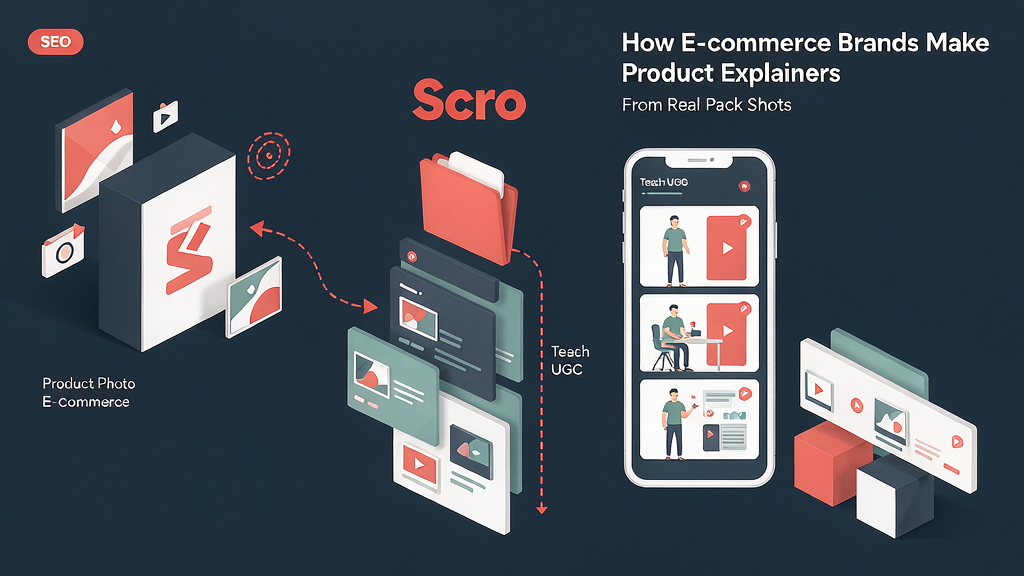
Stock lifestyle video is expensive. Fake “UGC” that invents customers is risky. The durable middle path for e-commerce is product explainers built from real pack shots—honest packaging, clear jobs-to-be-done, and vertical teach structure. This guide shows how brands turn existing photography into explainers that convert without a film crew.
Why pack-shot-first beats prompt-invented products
- Packaging matches what ships (trust)
- Claims stay reviewable
- SKUs stay distinct in a catalog
- Legal and brand teams can approve stills
AI can help with motion and hosts; it should not invent ingredients panels.
Asset checklist before creative starts
- Front/back pack shots on clean background
- In-hand scale reference
- Detail crops (texture, cap, label callouts)
- Logo master with clear space
- Claim sheet (approved adjectives and numbers)
Missing assets cause hallucinated labels later—fix the library first.
Explainer spine for 35–50 seconds
- Hook: the shopper pain
- Promise: one product job
- Pack hero: real front shot
- Proof 1: how it works / what’s inside (approved)
- Proof 2: use moment
- Recap + CTA: shop / learn more
Two proofs beat five feature bullets.
Production path
1) Storyboard with mandatory pack frames
Mark beats that must show the real pack. Do not leave those to generative guesswork.
2) Composite stills
Place pack shots into branded scenes; generate only backgrounds/hosts around the real product. Approve stills for label readability.
3) Motion with restraint
Prefer gentle moves and holds over chaotic camera. Shoppers need to read the pack.
4) Captions and offers
Mute-proof captions; one offer line max if paid social requires it. Keep organic teach versions offer-light.
Platform variants
- IG Reels / TikTok: 9:16 teach
- PDP embed: slower holds, 16:9 optional
- Paid: 15s hook + proof + CTA from same board
Scro supports product-photo → vertical teach workflows where pack references stay central and storyboards are approved before render credits burn.
Brand safety
- No fabricated reviews or celebrity clones
- No medical claims beyond approvals
- Disclose material connections where required
- Avoid “UGC style” that implies a real creator used the product when they did not
KPI set
- PDP conversion lift on SKUs with explainers
- Thumbstop rate and hold rate
- Save rate on organic teach cuts
- Return rate correlation (honest demos can reduce mismatch returns)
Weekly operating rhythm
Monday: pick 3 SKUs Tuesday: boards + still QA with brand Wednesday: render Thursday: publish + PDP embed Friday: note comments for FAQ Reels next week
Handoff templates (copy into your brief)
Job line: For [ICP], this helps them [job] so they can [outcome] without [pain]. Must-show: [asset/UI/pack]. Must-avoid: [claims, competitors, fake UI]. CTA: [one next step]. Success metric: [save rate / activation assist / demo mention].
Put the brief above the fold of every ticket. Designers and editors should not reverse-engineer intent from a Slack thread. After publish, paste the final URL and retention screenshot back into the ticket so future episodes inherit learning.
Pack-shot authority rules
- Front label is the source of truth for claims visible on pack
- Lighting should not invent neon colors marketing never approved
- Crop so regulatory text stays legible when it matters (supplements, foods)
- Never let the model “complete” ingredients or certifications
Platform variant matrix
| Platform | Length bias | Cover need | CTA style |
|---|---|---|---|
| IG Reels | 30–45s | High | Save + bio |
| TikTok | 30–50s | Medium | Series + shop |
| PDP embed | 20–35s | Low | Scroll to buy |
| Paid social | 15–30s | High | Hard offer |
Same board; different crops and CTA cards—not different product truths.
Weekly operating rhythm
- Mon: SKU pick + pack asset pull from DAM
- Tue: Job line + 5-beat board
- Wed: Still QA with brand + legal if claims
- Thu: Render + captions
- Fri: Publish + UTM + comment teaching replies
KPI set that matches commerce teach
Leading: saves, PDP click-through, add-to-cart assisted Quality: claim incidents, return-reason mentions of “not as shown” Lagging: return rate on SKUs with explainer coverage vs without (directional)
Anti-patterns
- Lifestyle-only videos that never show the pack
- Invented “#1 doctor recommended” badges
- Using a competitor’s bottle silhouette “for vibe”
Stakeholder email (copy)
Subject: Stills ready for lock (48h) Please comment by beat ID. Factual accuracy first. Motion starts after written lock. Credits after lock are change-order territory.
Distribution checklist
- Captions designed for muted autoplay
- Safe zones checked on a real phone
- First comment link / SKU details
- UTM or unique landing where relevant
- Day-3 and day-7 metrics logged
Related reading on Scro
- Best AI UGC Tools for E-commerce Product Explainers (Not Fake Reviews)
- Mistakes Brands Make When Using AI for Product UGC Explainers
- E-commerce Product Explainer Templates: Unbox, Demo, Compare, FAQ
- How to Make High-Retention Product Explainers for Instagram Reels
Operating checklist for this topic
- Write one job line before any generation
- List must-show visual references with links or file names
- Draft five to seven teach beats with spoken lines ≤18 words each
- Approve stills before motion credits useful
- Ship with captions, one CTA, disclosure if needed, and a verification date
- Log what you will change after three publishes
Anti-patterns to ban
- Regenerating motion to fix a brief problem
- Measuring success only as video count
- Skipping disclosure when using photoreal synthetic people
- Publishing UI or pack claims you did not verify
- Adding a sixth proof beat "just in case" after still lock
- Rewriting the job line silently during render week
Worked mini-example
Job line: teach one reversible mistake viewers already feel. Proof A: show the broken artifact (real photo or UI). Proof B: show the corrected method. Recap: three-step card. CTA: save or open the checklist.
If viewers save but do not click, your teach may already be complete—offer a Part 2 rather than stuffing more CTAs.
Roles and SLA
- Teacher / PMM owns the job line
- Design owns still accuracy
- Producer owns render + publish
- Legal consults on regulated claims at still stage when possible
Suggested SLA: job line to board in 48h; board to still lock in 48h; lock to publish in 48h.
Field notes and cleanup
Revisit after three related ships. Keep a changelog: job line, proof frames, retention notes, next change. Schedule quarterly cleanup for drifted product truth. Unpublish or rebuild rather than leaving inaccurate teach live.
Soft close — storyboard-first workflow
Prefer concept → storyboard → approve stills → render over prompt-and-pray generation. If you want that loop productized, try Scro. The operating rules above still apply with any stack that lets you lock beats before motion credits burn.