
How Coaches Sell Programs With Teach-First Explainer Funnels
Personal IP monetization works when you teach a reusable method, then bridge to an offer—without fake social proof. This playbook maps assets, ethical…
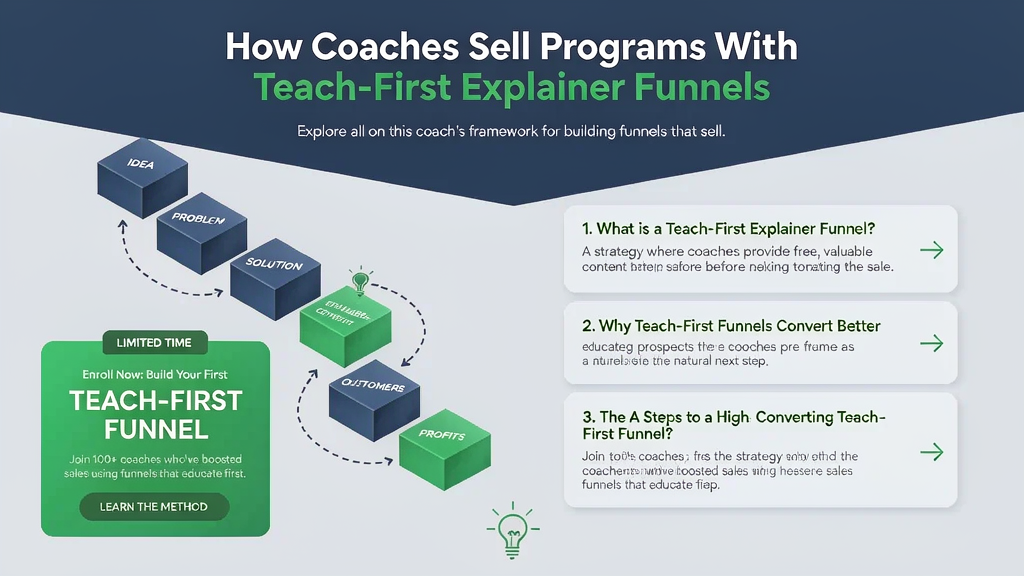
How Coaches Sell Programs With Teach-First Explainer Funnels
Personal IP monetization works when you teach a reusable method, then bridge to an offer—without fake social proof. This playbook maps assets, ethical constraints, and a content engine coach / educators can run weekly.
Why teach-first converts better than pitch-first
- Viewers save and share lessons more than ads
- Saves become trust deposits before checkout
- Objections surface in comments—you answer with Part 2, not DMs only
- Refund rates drop when buyers already tasted the method
Pitch-first can spike clicks; teach-first builds a buyer who knows what they’re buying.
Funnel spine (simple)
- Explainer Reels — myth-bust + mini-lessons from your method
- Lead magnet — checklist/template that continues the same job line
- Nurture — email/sequence with 3–5 deeper teaches
- Program offer — cohort or evergreen with clear outcomes
- Proof loop — alumni stories cut into new explainers
Every stage uses the same named framework language.
Implementation sprint (14 days)
Days 1–2: lock who you help and the one job line. Days 3–5: name the framework and board 6–8 explainer beats. Days 6–8: produce stills, approve, ship first 4 Reels. Days 9–11: attach one CTA path (lead magnet or offer). Days 12–14: measure saves, opt-ins, and reply quality; brief the next season.
RACI (solo-friendly)
- You own the job line and claims
- Designer/editor (or you) owns stills
- Legal/counsel for regulated niches
- VA/scheduler owns publish checklist. Keep a 48-hour self-lock on stills before motion so taste notes don’t eat the week
Practical examples you can adapt
Coach: “Run a 15-minute weekly review” — wrong scattered notes vs three-question template → CTA template. Consultant: “Scope projects without scope creep” — bad brief vs one-page brief → CTA checklist. Creator educator: “Pick one monetization path for 90 days” — funnel spaghetti vs primary+secondary → CTA spine worksheet.
Hook → promise → proof → recap → CTA. Swap nouns; keep the spine.
FAQ
Do I need to be on camera every day? No—systemize proofs; use face strategically. How many beats for ~45s? Usually five to seven. When do I launch a product? After public teach proof of the method. Can AI replace my expertise? No—AI accelerates production of your method.
Deeper operating notes
Treat every episode as a change to your brief template. If the brief does not change after you publish, the content was entertainment. Add fields for job line, proof refs, CTA target, and still approver. Train freelancers—or your future self—on those fields before granting generator access.
Run a monthly drift review: pick four published explainers and score job-line clarity, proof honesty, caption fidelity, and CTA congruence. Publish the scorecard in your notes. Drift review catches issues vanity analytics miss.
When a tool vendor demos cinema, ask them to demo a six-beat teach with still approval. If they cannot, categorize them as B-roll engines—useful, but not your explainer system of record for monetizable IP.
Ship checklist
- One job line only
- Must-show refs attached
- Stills approved by named owner
- Captions match on-screen nouns
- Safe zones clear on a real phone
- Single CTA
- Disclosure added if photoreal synthetic people appear
- Verification date recorded
Operating system (use on every episode)
- Write one job line (viewer outcome in one sentence)
- Draft five to seven beats with spoken lines ≤18 words each
- Attach must-show references (Diagram or worksheet still, not a fake testimonial face)
- Generate or shoot stills; QA before motion
- Render once the contact sheet is locked
- Caption for muted autoplay; single CTA
- Log verification date + what you will change next
Default job line pattern: Teach one reversible client mistake in under a minute.
Worked example (Coach / educator)
Job line: Teach one reversible client mistake in under a minute
Beat sheet (45–55s):
| Beat | On-screen | Spoken intent |
|---|---|---|
| Hook | Broken artifact or costly belief | Name the pain in one breath |
| Promise | Job line card | State the one outcome |
| Proof A | Diagram or worksheet still, not a fake testimonial face | Show the method |
| Proof B | Contrast / edge case | Prevent the usual failure |
| Recap | Three-step card | Repeat the promise in fewer words |
| CTA | End card | One next step (save, checklist, trial) |
Still QA (reject if): unreadable labels, invented UI, warped product geometry, extra logos, or claims legal did not approve.
Anti-patterns to ban
- Regenerating motion to fix a vague brief
- Measuring success only as “videos made”
- Clickbait hooks you cannot pay off in-frame
- Invented packaging, UI, or testimonials
- Six CTAs in one short
- Skipping still QA because “the model is better now”
FAQ
What should I monetize first? A framework you can teach repeatedly, bridged to a simple offer.
Are synthetic faces required? No—and fabricated testimonials are a trust risk.
Related reading on Scro
- Best AI Video Generators for Coaches Who Teach on Reels
- How Coaches Repurpose Course Outlines Into Scroll-Stopping Teach Reels
- How to Turn Customer Pain Points Into Hook-First Explainer Videos
- Storyboard-First Production for Creators Who Sell Knowledge
Soft close — storyboard-first workflow
Prefer concept → storyboard → approve stills → render over prompt-and-pray generation. If you want that loop productized, try Scro. The operating rules above still apply with any stack that lets you lock beats before motion credits burn.