
SEO GuidePersonal BrandCreator IPExplainer Reels
Authority Content vs Vanity Content: What Actually Builds Monetizable IP
To build monetizable IP, creators must focus on producing authority content that educates and provides value to their audience, rather than vanity…
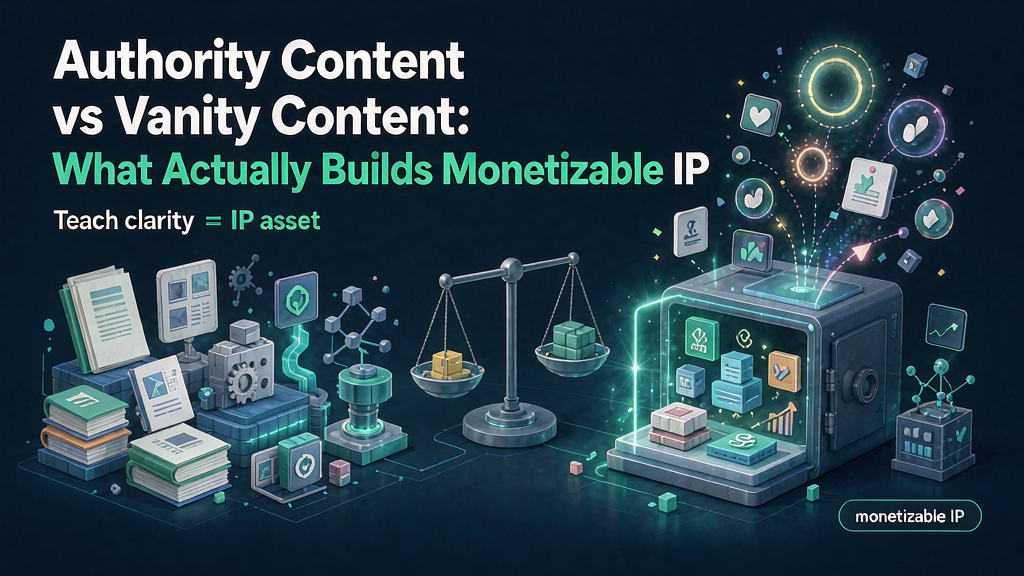
Authority Content vs Vanity Content: What Actually Builds Monetizable IP To build monetizable IP, creators must focus on producing authority content that educates and provides value to their audience, rather than vanity content that only seeks to entertain or inflate ego metrics. Authority content is characterized by its ability to drive change in viewer capability, provide visual proof, and connect to a named method or system. By prioritizing authority content, creators can establish themselves as experts in their field and attract a loyal following that is willing to pay for their products or services.
What Distinguishes Authority Content from Vanity Content? The key differences between authority content and vanity content lie in their goals, formats, and calls-to-action. Authority content aims to educate and provide value, while vanity content seeks to entertain or provoke a reaction. The following table highlights the main differences between the two:
| Vanity | Authority | |
|---|---|---|
| Goal | Applause, entertainment | Change in viewer capability |
| Format | Vague inspiration, flex, ragebait | Explainer with job line + proof |
| CTA | “Fire react” | Template / Part 2 / offer |
| Reuse | Low | High (boards → products) |
| Monetization link | Indirect/none | Direct ladder |
How to Evaluate Your Content: 5 Key Tests To determine whether your content is authority or vanity, ask yourself the following questions: 1. Can a stranger restate the outcome after one watch? 2. Is there a visual proof beyond your face? 3. Does it connect to a named method or system? 4. Could this become a module, template, or workshop slide? 5. Would you still ship it if likes were zero but saves were high? If most of your answers are no, it's likely that your content is vanity or entertainment-focused.
Building a Balanced Content Strategy Aim to achieve a ratio of 70% authority explainers, 20% personality bridge content, and 10% experimental content. Track your saves and opt-ins by type, and let the data guide your content decisions. This will help you strike a balance between providing value to your audience and showcasing your personality.
Compounding Your Authority Content Each strong explainer should spawn additional content, such as: A tweet or LinkedIn restatement A newsletter paragraph A lead-magnet section A course bullet This compounding effect can help you maximize the value of your authority content and attract more followers.
Production Implications of Authority Content Authority content requires more planning and production effort than vanity content. You'll need to create boards and stills, which can be time-consuming. Budget your time accordingly, and consider using tools to streamline your workflow.
Worked Example: Creating Authority Content for a Teach-Reel Let's say you're a fitness coach who wants to create a teach-reel on how to do a proper squat. To create authority content, you would: Develop a clear and concise script that explains the benefits and proper technique of the squat Create a storyboard and approve stills that illustrate the key points of the exercise Film the teach-reel using a high-quality camera and editing software Add visual proof, such as animations or graphics, to help illustrate the technique * Provide a clear call-to-action, such as a link to a free workout plan or a discount code for a fitness program
Second Worked Example: Creating Authority Content for a Business Topic Let's say you're a marketing expert who wants to create a teach-reel on how to create an effective social media strategy. To create authority content, you would: Develop a clear and concise script that explains the key elements of a social media strategy Create a storyboard and approve stills that illustrate the key points of the strategy Film the teach-reel using a high-quality camera and editing software Add visual proof, such as examples of successful social media campaigns, to help illustrate the strategy * Provide a clear call-to-action, such as a link to a free social media template or a discount code for a marketing course
Decision Table for Authority Content When deciding whether to create authority content, consider the following factors:
| Factor | Authority Content | Vanity Content |
|---|---|---|
| Time investment | High | Low |
| Production effort | High | Low |
| Value to audience | High | Low |
| Monetization potential | High | Low |
| Reuse potential | High | Low |
Failure Modes and Fixes Even with the best intentions, creators can still fall into common traps that prevent them from producing effective authority content. Here are some common failure modes and their fixes: Failure mode: Lack of clarity. Fix: Develop a clear and concise script, and test it with a small audience before filming. Failure mode: Insufficient visual proof. Fix: Add animations, graphics, or examples to illustrate key points and provide visual proof. Failure mode: No clear call-to-action. Fix: Provide a clear call-to-action, such as a link to a free resource or a discount code for a product. Failure mode: Poor production quality. Fix: Invest in high-quality camera and editing software, and consider hiring a professional to help with production.
Ship Checklist for Authority Content Before shipping your authority content, make sure you've completed the following tasks: Developed a clear and concise script Created a storyboard and approved stills Filmed and edited the content using high-quality equipment and software Added visual proof and graphics to illustrate key points Provided a clear call-to-action Tested and refined the content based on feedback from your audience
Turning Authority Content into IP Assets To turn your authority content into IP assets, consider the following strategies: Break down your content into smaller, reusable pieces, such as tweets, LinkedIn posts, or newsletter paragraphs Use your content to create lead magnets, such as free ebooks or webinars Develop a course or workshop based on your content Use your content to create products, such as video series or membership sites By following these strategies, you can maximize the value of your authority content and build a loyal following that is willing to pay for your products or services.
Culture Check for Teams and Assistants When working with teams or assistants, make sure to brief them on the importance of creating authority content. Provide them with the 5 key tests and pay them for approved explainers, rather than for hours of content. This will help ensure that your team is focused on creating high-quality, valuable content that drives results.
Related reading on Scro
- Turning Customer Questions Into Monetizable Explainer IP
- Creator IP Business Models: Courses, Sponsorships, Digital Products, Reels
- From LinkedIn Posts to Paid Community: Explainer Content That Converts
- How Solopreneurs Replace “Always On Camera” With a Content System
Soft close — storyboard-first workflow
Prefer concept → storyboard → approve stills → render over prompt-and-pray generation. If you want that loop productized, try Scro. The operating rules above still apply with any stack that lets you lock beats before motion credits burn.